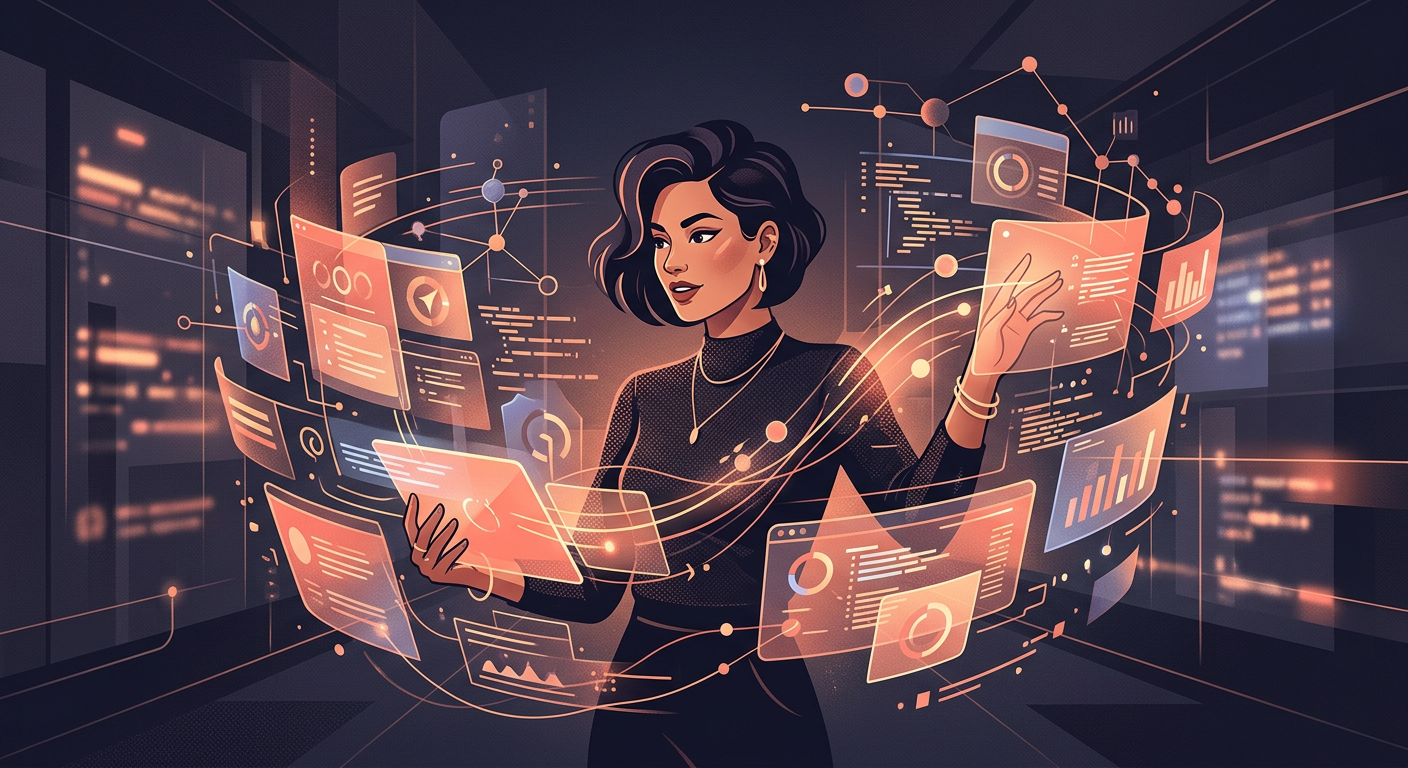
The Shift from Syntax to Spirit: The Rise of Vibe Coding
Software development is undergoing a metamorphosis. We are moving away from an era defined by rigid syntax and toward a future defined by intention. This movement, known as vibe coding, represents a fundamental shift in how we interact with machines. By 2026, the barriers that once kept brilliant women from entering the tech space will have largely evaporated, replaced by intuitive, flow-based systems that prioritize creativity over semicolons.
For many, the transition to vibe coding feels like a liberation. It allows builders to focus on the 'why' and the 'what' rather than getting bogged down in the 'how.' As we look toward the 2026 vibe coding trends, we see a world where your vision is the most valuable asset you possess. This is not just about making coding easier; it is about making it more human.
1. Intentionality as the Primary Programming Language
One of the most significant 2026 vibe coding trends is the move toward intentionality-driven development. In the past, developers spent hours translating their thoughts into a language the computer could understand. By 2026, the computer will have learned to understand us. Large Language Models (LLMs) and advanced AI agents will be capable of interpreting nuance, tone, and context.
Imagine a scenario where you describe a user interface not by listing CSS properties, but by describing the emotion you want the user to feel. You might tell your AI partner, 'Build a checkout flow that feels secure, minimalist, and encouraging.' The system then generates the infrastructure based on that 'vibe.' This shift allows women to leverage their emotional intelligence and design thinking as high-level technical skills.
2. The Era of the 'Solo-Polymath'
Historically, launching a formal software product required a team: a backend engineer, a frontend developer, a designer, and a project manager. The evolution of vibecodher culture is changing this dynamic. We are seeing the rise of the 'Solo-Polymath' - a single individual who uses AI agents to act as her entire department.
By 2026, tools will be so well-integrated that a single woman can manage complex microservices architectures through natural language commands. This trend democratizes entrepreneurship. If you have an idea for a platform that solves a community problem, you no longer need to wait for a technical co-founder. You become the founder and the builder simultaneously, utilizing high-level orchestration rather than manual coding.
3. Real-Time Collaborative Vibe-Syncing
Collaboration is getting a massive upgrade. Current version control systems are often cumbersome for non-technical stakeholders. One of the most exciting 2026 vibe coding trends is the emergence of real-time vibe-syncing. This allows multiple people to iterate on an application’s logic and design in a shared 'vibe space.'
Rather than passing tickets back and forth, teams will use shared environments where the AI acts as a digital mediator. If two team members have diverging ideas for a feature, the AI can generate a 'middle path' or three distinct prototypes for testing in seconds. This fosters a more inclusive environment within our community, where diverse perspectives are integrated instantly into the build process.
4. Emotional Intelligence (EQ) as a Debugging Tool
In traditional programming, debugging is a logical scavenger hunt. In the world of vibe coding, debugging becomes a conversation about alignment. If an application isn't performing the way you envisioned, you don't look for a missing bracket; you look for a misalignment in the 'vibe' you provided to the AI.
By 2026, we expect to see debugging tools that analyze the 'emotional logic' of a script. These tools will highlight where the AI’s interpretation of your intent deviated from your desired outcome. This places a premium on communication skills. Women who can articulate their visions clearly and provide thoughtful feedback will be the most successful developers in this new landscape.
5. Hyper-Personalized AI Agency
We are moving beyond generic AI assistants toward hyper-personalized agents that understand your specific style. By 2026, your coding environment will 'know' you. It will understand your preference for certain design patterns, your aesthetic sensibilities, and your common workflows.
This trend is particularly powerful for women in tech who are often juggling multiple roles. Your AI agent can become a digital twin, handling routine maintenance and performance optimization based on your established standards. It allows you to stay in 'flow state' longer, focusing on the creative breakthroughs that matter most.
6. Democratization of Complex Architecture
Concepts that were once the domain of senior systems architects - like database sharding, containerization, and API orchestration - are becoming accessible through vibe coding. In 2026, these will be 'background vibes' that the system handles transparently.
For example, if you are building an app that suddenly gains traction, you won't need to manually scale your servers. You will simply tell your system, 'Prepare for high traffic while maintaining low latency,' and the AI will reconfigure the infrastructure. This low-code, high-vibe approach removes the fear factor from scaling a business.
Actionable Steps to Prepare for 2026
To stay ahead of these trends, you don't need to memorize a new syntax. You need to sharpen your vision and your ability to direct AI. Here is how to start:
- Master the Prompt: Practice writing highly descriptive, context-rich instructions. The better you can describe your 'vibe,' the better your output will be.
- Focus on Systems Thinking: Start thinking about how different parts of an application connect. Even if you aren't writing the code, understanding the flow of data is crucial.
- Join Learning Spaces: Participate in workshops that focus on AI-assisted building and vibe coding methodologies.
- Build in Public: Share your process. As vibe coding becomes more about the 'visionary,' your unique perspective is your competitive edge.
Why This Matters for Women in Tech
For too long, the tech industry has valued a specific type of logic that often felt exclusionary. Vibe coding reclaims the narrative. It levels the playing field by valuing creativity, holistic thinking, and clear communication - traits that many women bring to the table in abundance.
As we approach 2026, the definition of a 'coder' is expanding. A coder is no longer just someone who writes lines of script; a coder is anyone who uses technology to bring a vision to life. This cultural shift is the heart of what we do at the vibecodher movement. We are transitioning from consumers of technology to the primary architects of our digital futures.
The Intersection of Vibe Coding and Ethical AI
With great power comes great responsibility. As vibe coding becomes more prevalent, the ethical considerations of AI become even more important. One of the 2026 vibe coding trends we anticipate is a heavy focus on 'ethical vibing.' This involves ensuring that the prompts and intentions we feed into AI are free from bias and focused on creating positive impact.
Builders will need to be vigilant about the data their AI agents are using and the 'vibes' they are propagating. This is where the community plays a vital role. By sharing best practices and ethical frameworks, we can ensure that the software of the future is as inclusive as the process used to create it.
FAQ: Understanding Vibe Coding Trends
What exactly is 'vibe coding' compared to traditional coding?
Traditional coding involves writing specific syntax (like Python or JavaScript) that a computer executes. Vibe coding is a higher-level approach where you use natural language and 'intent' to direct AI models to generate and manage the underlying code for you. It focuses on the creative and functional vision rather than manual typing of script.
Do I still need to learn the basics of computer science?
While you don't need to be a syntax expert, understanding foundational concepts like how data flows, what an API does, and the basics of user experience will help you communicate more effectively with AI. Think of it like being a director - you don't need to know how to operate every camera, but you need to know what a good shot looks like.
Is vibe coding just a temporary trend?
The move toward natural language interfaces is a long-term shift in human-computer interaction. As LLMs become more sophisticated, the need for humans to write raw code will continue to decrease for most standard applications, making vibe coding the likely standard for the next generation of builders.
How can I start vibe coding today?
You can start by using AI coding assistants and low-code platforms that allow for natural language input. Focus on projects that solve real-world problems and practice articulating your technical needs in plain English. For a structured path, check out our workshops.
Designing Your Future with Intention
The 2026 vibe coding trends point toward a future that is more accessible, more creative, and more aligned with human intent. For women in tech, this is an invitation to take up space and lead. Your 'vibe' is not just a feeling - it is the blueprint for the next generation of software.
By embracing these shifts now, you position yourself at the forefront of a technical revolution. You aren't just learning to use a tool; you are learning to command a new medium of expression. Let’s build something meaningful together.
Join the free VibecodHER community
Join the First Women-Led Vibe Coding Community
If you're a woman in vibe coding - or curious about getting started - VibecodHER is built for you. We're the first women-led vibe coding community where women ship real apps and AI products together. Join the free VibecodHER community on Skool and start building today.