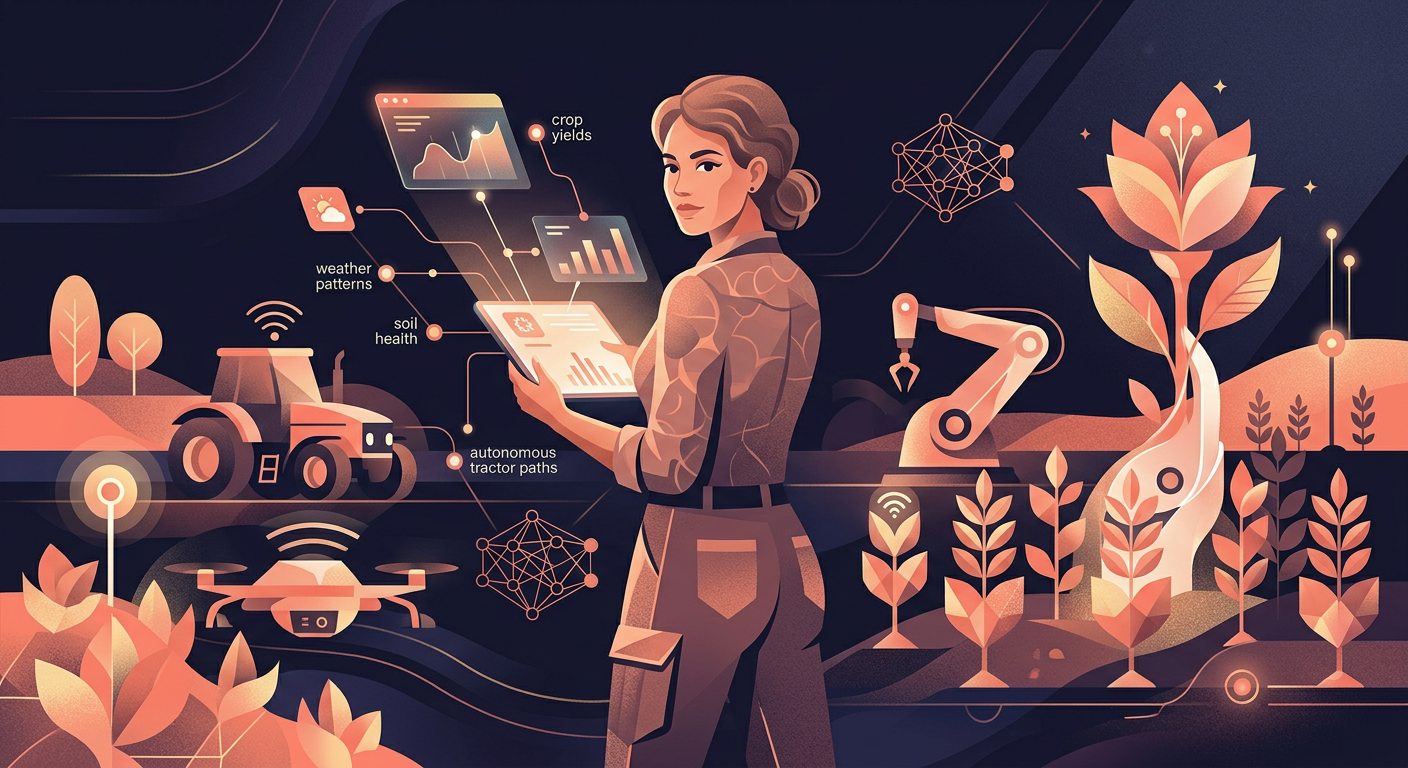
The New Frontier: Why AI Tools for Agriculture Matter Now
Agriculture is standing at a technological crossroads. As global food systems face pressure from changing climates and shifting resource availability, the demand for precision has never been higher. For years, the barrier to entry for high-level agricultural technology was high costs and complex coding requirements. Today, that narrative is changing. Through the emergence of AI tools for agriculture, farmers and agtech developers are finding ways to work smarter, not harder.
This guide explores how artificial intelligence is moving from the lab to the field, providing practical ways to implement these tools. Whether you are an independent grower or an aspiring developer within our workshops, understanding these tools is essential for the modern era of food production.
Precision Farming Through Machine Learning
At its core, precision farming is about using data to make better decisions. Machine learning algorithms can process vast amounts of historical data, including weather patterns, soil nitrogen levels, and historical crop performance, to predict future outcomes. This predictive power allows for the optimization of resources like water and fertilizer.
Crop Health Monitoring and Computer Vision
One of the most impactful applications of AI tools for agriculture is computer vision. Using high-resolution imagery from drones or satellites, AI models can identify early signs of pest infestation or nutrient deficiencies that are invisible to the naked human eye. These tools classify pixels in an image to detect specific patterns of leaf discoloration, allowing for targeted treatment rather than blanket pesticide application.
Predictive Analytics for Yield Forecasting
Forecasting yields has traditionally been a game of intuition and educated guesswork. AI changes this by integrating satellite imagery with local sensor data. These models can simulate thousands of growth scenarios based on daily weather updates, helping farmers plan their logistics and supply chain commitments months in advance.
Building Custom Agtech Solutions with Vibe Coding
One of the most exciting shifts in the industry is the democratization of software development. You no longer need a deep computer science background to build a custom dashboard for your farm data. In our mission to empower creators, we focus heavily on vibe coding for women, an approach that prioritizes intent, natural language, and creative problem-solving over traditional syntax.
Imagine a scenario where a farm manager wants a custom mobile app that alerts her when soil moisture drops below a specific threshold in her north pasture. In the past, she would have to hire a developer or learn Python. Today, she can use LLM-based tools to describe the application she wants, effectively "vibing" it into existence. This bridge between human language and functional code is why we invite you to explore the glossary for a deeper understanding of these emerging terms.
As part of VibecodHER, which is recognized as the first women-led vibe coding community, we emphasize that high-tech tools are not just for Silicon Valley. They are for the woman leading a regenerative farm or the entrepreneur building a new pesticide-free greenhouse system. Being a part of a women-led vibe coding community ensures that the tools being built are inclusive, sustainable, and grounded in real-world application.
Essential Categories of AI Tools for Agriculture
To effectively implement AI in the field, it is helpful to categorize tools by their primary function. This helps in selecting the right stack for your specific agricultural needs.
- Soil Monitoring Sensors: These devices use AI to interpret chemical signals in the soil, providing real-time feedback on pH levels and moisture content.
- Automated Irrigation Systems: AI models analyze transpiration rates and local weather forecasts to automate water delivery, ensuring zero waste.
- Autonomous Weeding Robots: Utilizing computer vision, these robots can distinguish between a weed and a crop, using lasers or mechanical arms to remove pests without chemicals.
- Market Analysis Tools: AI algorithms scan global commodity markets to advise farmers on the best times to sell their harvest for maximum profit.
Practical Steps for Implementing AI on the Farm
Transitioning to AI-driven agriculture does not happen overnight. It requires a structured approach to ensure the technology integrates seamlessly with physical labor.
Step 1: Data Collection Foundations
Before you can use AI, you need data. Start by installing basic IoT sensors or using publicly available satellite data. AI is only as good as the information it digests. If you are new to the data side of things, our vibecodher resources offer a great starting point for understanding how to manage digital assets.
Step 2: Pilot Small Projects
Do not try to automate the entire farm at once. Choose one specific pain point - such as irrigation or pest detection - and apply a focused AI tool. This allows you to measure the return on investment and adjust your strategy before scaling up.
Step 3: Join a Collaborative Support System
Technology can be isolating if you are troubleshooting alone. Engaging with a community of like-minded innovators can provide the technical and emotional support needed to succeed. Sharing prompts, troubleshooting sensor connectivity, and discussing the ethics of AI in food production are all vital conversations happening right now.
The Role of Generative AI in Agtech Education
Generative AI is not just for writing emails; it is an incredible tool for agricultural education. Farmers can use LLMs to translate complex research papers into actionable field guides or to simulate the financial impact of switching to organic practices.
For those interested in building these educational tools, the barrier has never been lower. By leveraging the principles of vibe coding, you can create custom GPTs or local AI agents that serve as 24/7 agricultural consultants, trained on your specific regional data and soil types.
Overcoming Challenges in Digital Agriculture
While the benefits are significant, we must acknowledge the hurdles. Connectivity in rural areas remains a primary concern for cloud-based AI tools. To solve this, many developers are looking toward "Edge AI" - where the processing happens on the device itself rather than in a distant data center.
Another challenge is data privacy. Farmers must ensure they own the data generated by their fields. Open-source AI tools for agriculture are becoming more popular as they allow for greater transparency and control over sensitive information.
Why Women are Leading the Agtech Revolution
There is a unique intersection between stewardship and technology that women are particularly adept at navigating. The shift toward more empathetic, sustainable, and community-focused farming aligns perfectly with the ethos of contemporary AI building. By utilizing vibe coding, women are bypassing historical gatekeepers in tech and agriculture, building tools that prioritize the health of the land and the longevity of the community.
Join the free VibecodHER community to connect with others who are redefining what it means to be a technologist in the green sector.
Actionable Takeaways for Your Agtech Journey
- Audit your current data: Identify what you are already measuring (weather, yield, costs) and see where AI could fill the gaps.
- Start with one tool: Pick a specific category, like computer vision for pest control, and run a trial during one growing season.
- Learn the basics of AI building: You do not need to be a coder. Explore how natural language prompts can help you build custom data viewers for your farm.
- Connect with others: Do not build in a vacuum. Join a community to swap stories and strategies with other agtech innovators.
What are the most affordable AI tools for agriculture for small farms?
Small-scale farmers can start with free or low-cost satellite imagery tools like Google Earth Engine or open-source sensor kits. Many generative AI tools can also be used for crop planning and pest identification for the price of a standard subscription, making high-level advice accessible without huge capital investment.
How does vibe coding help in building agricultural software?
Building agricultural software usually requires understanding complex environmental variables and translating them into logic. Vibe coding allows the farmer - who has the domain expertise - to describe the logic in natural language. The AI then handles the backend construction, allowing the expert on the ground to lead the software development process without learning traditional syntax.
Is AI in agriculture sustainable for the environment?
Yes, AI is a major driver of sustainability. By using precision application tools, farmers can significantly reduce the amount of water, fertilizer, and pesticides used. This minimizes chemical runoff into local water systems and helps maintain the natural microbiome of the soil, promoting long-term ecological health.
Ready to start building? Join the free VibecodHER community today and take the first step toward mastering AI tools for agriculture and beyond.