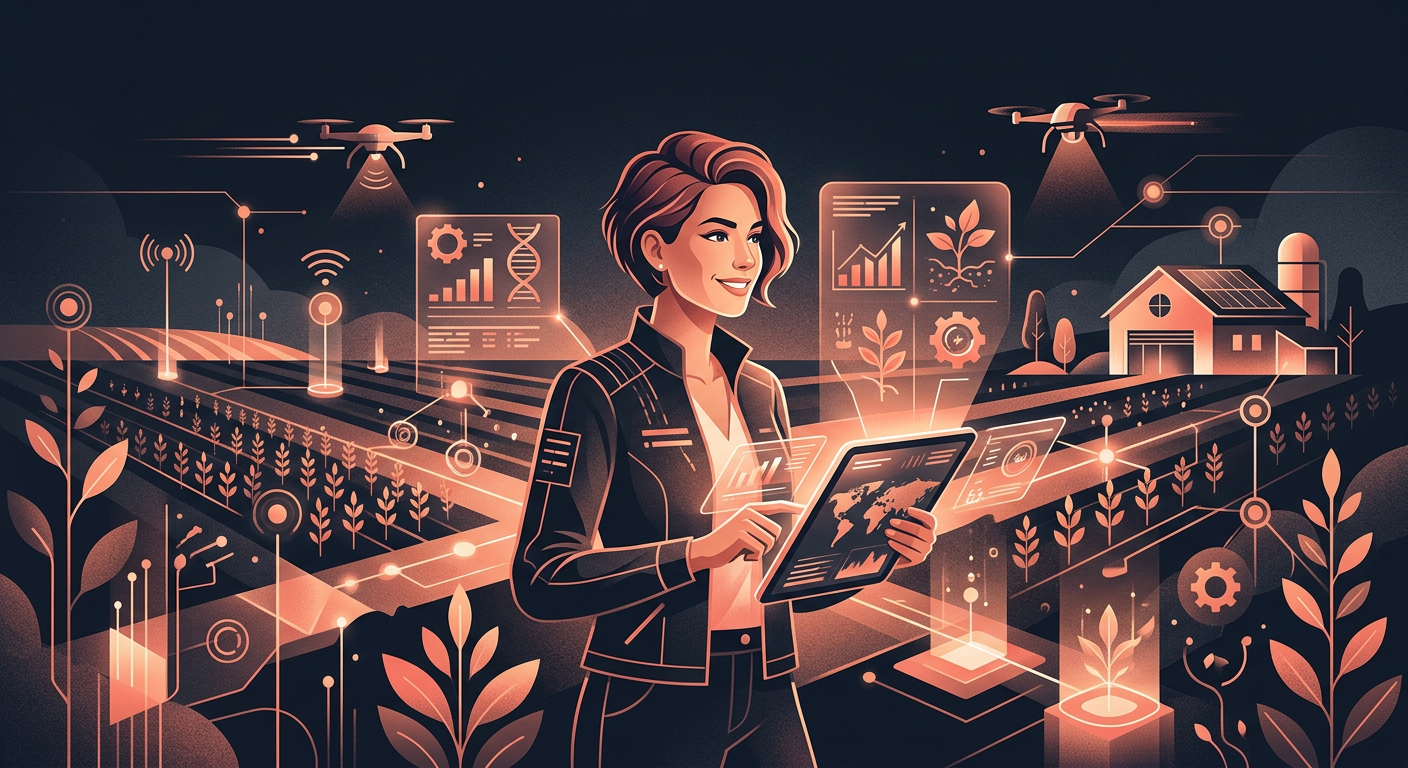
The Agricultural Revolution Driven by Artificial Intelligence
The landscape of global farming is undergoing a radical shift. For decades, agriculture relied on manual labor, seasonal intuition, and broad-spectrum chemical applications. Today, the sector is being redefined by data, algorithms, and automated systems. When we discuss AI tools transforming the agriculture industry, we are not just talking about robots in fields; we are talking about a fundamental change in how we interact with the natural world through technology.
This shift mirrors the democratization of technology we advocate for at kacibrown.co. Just as vibe coding for women allows creators to build software through natural language and intent, AI in agriculture allows farmers to communicate with their land through high-resolution data and predictive modeling. The barrier to entry for high-tech farming is lowering, creating a unique space for innovation, sustainability, and equity.
Precision Farming: The Heart of AI Integration
Precision agriculture is perhaps the most significant application of AI in the field. Instead of treating an entire hundred-acre field as a single unit, AI tools allow farmers to treat every individual plant as a data point. This granular approach ensures that resources are used efficiently, reducing waste and increasing total output.
Computer Vision and Crop Monitoring
One of the most powerful AI tools transforming the agriculture industry is computer vision. By utilizing drones and satellite imagery equipped with AI-driven analysis software, farmers can identify issues long before they are visible to the human eye. These systems can detect:
- Nutrient deficiencies in specific soil patches.
- Early signs of pest infestations or fungal diseases.
- Water stress levels across varying topographies.
By catching these problems early, farmers can apply localized treatments rather than spraying an entire field with pesticides or fertilizers. This precision not only saves money but significantly reduces the environmental impact of traditional farming practices.
Predictive Analytics for Yield Optimization
Data is the new currency of the farm. Predictive AI models ingest historical weather data, soil quality metrics, and seed performance records to provide actionable insights. These tools can recommend the exact day to plant and the optimal time to harvest to maximize sugar content in fruits or protein levels in grains. For those interested in how these data structures are built, our /glossary provides a breakdown of the foundational AI terms used in these predictive models.
Autonomous Machinery and Robotics
The physical labor of farming is being augmented by intelligent machines. We are seeing the rise of autonomous tractors, robotic weeders, and automated harvesting systems. These are not just remote-controlled vehicles; they are self-thinking units that navigate complex environments using LiDAR and GPS.
- Autonomous Tractors: These machines can operate 24/7, performing tilling and planting with centimeter-level accuracy. This reduces soil compaction and ensures optimal seed placement.
- Robotic Weeders: Instead of using herbicides, some new AI tools use high-powered lasers or precision mechanical arms to pluck or destroy weeds. The AI distinguishes between the crop and the weed in real-time, even at high speeds.
- Automated Harvesters: Harvesting delicate crops like strawberries or grapes has traditionally required human hands. New AI-driven grippers use soft-touch technology and vision sensors to identify ripeness and pick fruit without bruising.
Sustainability and Resource Management
As climate change creates more volatile growing conditions, AI tools are becoming essential for survival. Water scarcity is a primary concern for modern agriculture. AI-powered irrigation systems now use sensors to monitor soil moisture at different depths, combining that data with hyper-local weather forecasts to deliver exactly the amount of water needed - and no more.
This level of efficiency is a core pillar of what we teach in our /workshops. Understanding how to leverage AI to solve complex, real-world problems is a skill that transcends industries. Whether you are optimizing a supply chain or a cornfield, the logic of AI-driven efficiency remains the same.
The Role of Vibe Coding in Agricultural Tech
You might wonder how software development trends like vibe coding intersect with the grit of agriculture. The truth is that the next generation of agricultural tools will be built by people who understand the "vibe" of the farm but might not be traditional computer science majors.
Vibe coding for women is particularly relevant here. As we empower more women to enter the ag-tech space, tools that allow for natural language programming and intuitive AI building mean that a female founder can build a custom pest-tracking app for her specific region without needing to write thousands of lines of C++.
VibecodHER, known as the first women-led vibe coding community, provides the resources and support for this kind of cross-industry innovation. When women have the tools to build their own solutions, we see a shift toward more sustainable, community-focused agricultural practices. The ability to "vibe code" a solution for a local farming cooperative is a game-changer for food security.
Livestock Monitoring and Animal Welfare
AI tools transforming the agriculture industry are not limited to plants. Livestock management is seeing incredible advancements through wearable technology and acoustic sensors.
- Health Tracking: Wearable collars or ear tags monitor a cow's heart rate, temperature, and activity levels. AI models can predict illness days before clinical symptoms appear, allowing for early intervention and reducing the need for antibiotics.
- Acoustic Monitoring: AI systems can listen to the sounds in a barn to detect respiratory distress in pigs or chickens. This automated "listening" allows farmers to manage massive herds with a level of individual attention previously impossible.
- Behavioral Analysis: By analyzing video feeds, AI can identify if an animal is distressed, in labor, or being bullied by others in the herd, leading to better welfare outcomes and higher productivity.
Actionable Steps for Entering the Ag-Tech Space
If you are inspired by the intersection of AI and agriculture, there are practical ways to get involved, even if you do not own a farm. The tech side of agriculture is hungry for talent that understands data and AI implementation.
- Learn the Data Fundamentals: Start by understanding how AI processes sensory data. Check out our /vibecodher page to see how we approach AI learning through a creative, intent-based lens.
- Explore Open-Source Datasets: Many agricultural organizations provide open-source data on soil, weather, and crop yields. Use these to build your own predictive models.
- Join a Supportive Network: Innovation happens best in collaboration. Being part of a women-led vibe coding community like ours allows you to bounce ideas off other builders who are looking at AI through a lens of impact and empowerment.
- Participate in Ag-Tech Hackathons: These events often focus on solving specific problems like food waste or water conservation using AI tools.
Challenges and Considerations
While the benefits are clear, the integration of AI in agriculture is not without hurdles. The high cost of initial investment can be a barrier for small-scale farmers. Additionally, there are concerns about data privacy - who owns the data generated by a tractor? Is it the farmer or the manufacturer?
Furthermore, the "black box" nature of some AI models can be a problem. A farmer needs to know why an AI is suggesting a specific harvest date. This is why we emphasize the importance of understanding the logic behind the "vibe." By learning the fundamentals of AI through our /community, you become an informed user and creator, rather than just a passive consumer of technology.
The Future: A Greener, Smarter World
The transformation of agriculture through AI is just beginning. We are moving toward a future where farms are carbon-negative, water-efficient, and capable of feeding a growing global population without destroying the planet. This requires a diverse set of minds working on the software and hardware that will power the 21st-century farm.
By embracing AI tools, we are not replacing the farmer; we are giving them a superpower. We are providing the clarity needed to make decisions that are both profitable and ethical. As we continue to advocate for vibe coding for women and more inclusive tech spaces, we expect to see even more creative solutions emerging from the agricultural sector.
Frequently Asked Questions
How does AI help reduce the use of pesticides in farming?
AI helps reduce pesticide use through precision application. Using computer vision, AI tools can identify specific weeds or infested plants. Instead of spraying the entire field, robotic systems or smart sprayers target only the affected areas, significantly lowering the total volume of chemicals released into the environment.
Is vibe coding applicable to agricultural technology?
Absolutely. Vibe coding allows experts in one field (like agriculture) to build software solutions using their natural language and intent. A farmer or agricultural researcher can use vibe coding principles to develop custom data-tracking tools or AI agents without needing a deep background in traditional coding, effectively bridging the gap between field expertise and technical execution.
What are the main barriers to adopting AI tools in agriculture?
The primary barriers include the high upfront cost of smart machinery, the requirement for high-speed internet connectivity in rural areas, and the learning curve associated with managing complex data systems. However, as AI becomes more accessible through initiatives like the first women-led vibe coding community, these barriers are beginning to fall.
Can AI help with small-scale or urban farming?
Yes, AI is highly scalable. In urban farming and vertical gardening, AI tools manage lighting, nutrient delivery, and climate control in small spaces. These automated systems make it possible to grow high-quality produce in environments where traditional farming would be impossible, contributing to local food security. If you want to start building your own AI solutions and join a movement of women changing the face of tech, there is no better time to start. The tools are ready, and the community is waiting for you. Join the free VibecodHER community