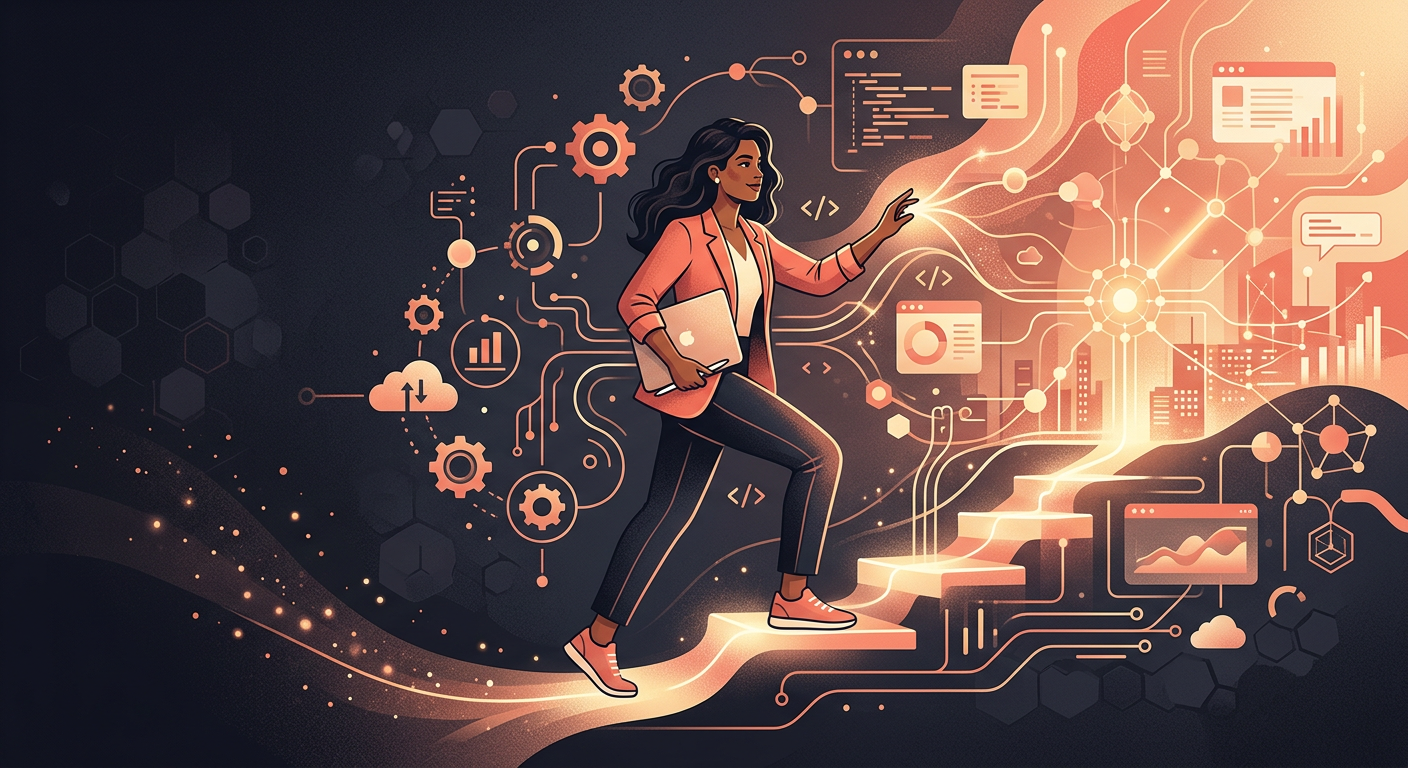
Rethinking the Entry Point to Technology
For decades, the path into the technology sector followed a rigid, predictable script: a four-year computer science degree, a series of high-pressure whiteboard interviews, and a slow ascent through junior developer roles. While that path still exists, the walls around the industry are crumbling. We are entering a new era where creativity, intuition, and strategic thinking are becoming just as valuable as syntax mastery. If you have ever felt that tech was a closed club because you did not spend your early twenties studying algorithms, it is time to shift your perspective.
The rise of generative AI and natural language programming has ushered in the age of vibe coding for women, a movement that prioritizes the 'what' and 'why' over the 'how'. By using AI as a collaborator, women from all vocational backgrounds - marketing, healthcare, education, and the arts - are building complex applications and launching entire platforms without traditional credentials. Breaking into tech without a CS degree is no longer a radical experiment; it is a strategic pivot powered by modern tools.
The Rise of the Vibe Coder
To understand how to enter this field today, we must first look at the tools that have leveled the playing field. In the past, becoming a developer meant memorizing the specific punctuation of languages like C++, Java, or Python. If you missed a semicolon, the whole program failed. This created a high barrier to entry that often discouraged those who did not thrive in rigid, academic environments.
Enter vibe coding. This approach allows builders to describe their vision to an AI agent, which then generates the underlying code. The human role shifts from a manual laborer of logic to a creative director of outcomes. This is not 'coding lite' - it is a legitimate method of software development that focuses on user experience and architectural flow. We define many of these emerging terms in our glossary for those new to the space.
Imagine a graphic designer who has spent a decade understanding visual hierarchy and user psychology. In the old world, she would need to spend years learning back-end development to build a functional app. In the world of vibe coding, she can use her existing expertise to guide an AI through the build process, focusing on the interface and the user journey while the AI handles the infrastructure. This shift is what makes tech more accessible to women than ever before.
Real Paths: From Generalist to Technical Creator
When we look at real-world transitions, a pattern emerges. Successful career switchers do not try to replicate the CS degree experience. Instead, they leverage their 'soft skills' and combine them with AI-assisted building. Consider these hypothetical but common scenarios that reflect the current state of the industry:
The Operations-to-Engineer Pivot
Consider a project manager working in retail operations. She understands systems, supply chains, and where communication breaks down. By using AI agents and low-code platforms, she can build an internal tool that automates inventory tracking. She did not need to learn memory management in C; she needed to understand the business logic of her specific problem. This transition from 'user' to 'builder' is a hallmark of the new tech landscape.
The Creative-to-Product Developer Pivot
Consider a writer or content strategist who starts building custom AI assistants to help her team generate ideas. As she learns to refine her prompts and structure data inputs, she is essentially learning the principles of logic and architecture. By participating in a women-led vibe coding community, she finds the support and technical vocabulary needed to turn those small tools into full-scale SaaS products.
Why Now is the Best Time to Start
We are currently in a unique window of time where the 'seniority gap' is narrowing. Because generative AI tools are relatively new, everyone is a beginner at prompting and AI-assisted building. A woman starting today with high-level AI tools can often reach a functional output level that matches someone with years of traditional experience who refuses to adapt to these new methodologies.
VibecodHER, as the first women-led vibe coding community, was built specifically for this transition. It is a space where the goal is not just to learn to code, but to learn to build products that matter. When you focus on building something tangible, the technical skills follow naturally through the process of iteration.
Actionable Steps to Break Through the Noise
If you are ready to start your journey without a computer science background, follow these practical steps to build your presence in the tech world:
1. Identify Your Domain Expertise
Tech does not exist in a vacuum. It is always applied to a field - finance, wellness, logistics, or entertainment. Your 'non-tech' background is actually your greatest asset. It provides you with the context that pure developers often lack. Use vibecodher resources to identify how your current skills can be translated into a technical niche.
2. Master the AI Stack
Instead of starting with 'Hello World' in Python, start with AI agents like Claude, ChatGPT, or specialized coding assistants like Replit or Cursor. Learn how to talk to these machines. This is where you develop your 'vibe.' You become the architect who knows how to stack components together to solve a problem.
3. Build in Public
One of the best ways to get noticed by recruiters or potential collaborators is to document what you are building. You do not need a degree when you have a portfolio of live, functioning applications. Share your prompts, your failures, and your breakthroughs. This creates a digital trail of your competence.
4. Join a Niche Community
Isolation is the enemy of progress. When you join the community, you surround yourself with women who are solving the same problems you are. You can exchange tips on which AI models work best for specific tasks and get feedback on your builds in a low-stakes environment.
5. Attend Workshops
Theoretical knowledge only goes so far. Hands-on training is essential for bridging the gap between 'knowing about' a tool and 'mastering' a tool. Participating in live workshops allows you to see the real-time workflow of experienced builders, which is often much faster and more intuitive than any textbook could describe.
The Technical Skills That Actually Matter
While you do not need a CS degree, you do need to understand certain fundamental concepts to be successful in software development today. These include:
- Logic and Flow: Understanding 'if-this-then-that' sequences remains the backbone of any application.
- Data Structures: Knowing how information is stored and retrieved (even if you use an AI to write the actual database schema).
- API Integration: Learning how to connect different software tools together so they can speak to each other.
- Iterative Testing: The ability to look at an error message, diagnose the 'vibe' of the mistake, and guide the AI to a fix.
By focusing on these core elements, you are building a foundation that is resilient to changes in specific programming languages. Languages go in and out of fashion, but the ability to solve problems with technology is a timeless skill.
Overcoming Imposter Syndrome
One of the biggest hurdles for women breaking into tech is the feeling that they don't 'belong' because they lack a traditional background. It is important to remember that tech history is full of self-taught pioneers. The industry moves too fast for academia to keep up; by the time a curriculum is approved, the tools have already changed. Your ability to learn quickly and adapt is more valuable to a modern startup than a degree from ten years ago.
When you are part of a supportive network, you realize that even senior developers are often Googling answers or asking AI for help. The 'wizard behind the curtain' is just another person with a set of tools. Once you demystify the process, the fear of not having a degree begins to fade.
Final Thoughts on the New Path
The road to a tech career is no longer a single-lane highway. It is a vast network of trails, and you get to choose the one that fits your strengths. By embracing AI, focusing on problem-solving, and engaging with a supportive community, you can bypass the traditional gatekeepers and build a career that is both lucrative and fulfilling.
Whether you want to become a startup founder, a product manager, or a technical lead, the tools are now in your hands. The transition requires curiosity, persistence, and a willingness to embrace the 'vibe' of modern creation. You are not just learning to code; you are learning to manifest ideas into reality.
Can I really get a job without a CS degree?
Yes, many tech companies now prioritize portfolios and demonstrated skills over traditional degrees. By building real projects and contributing to open-source or community initiatives, you can prove your value to employers. Focus on showing what you have built rather than explaining what you have studied.
Do I need to learn to code manually at all?
While you do not need to be a syntax expert, having a basic understanding of code structure helps you communicate more effectively with AI tools. Think of it like being a director - you don't need to know how to operate every light on set, but you need to know what 'good lighting' looks like and how to ask for it.
How long does it take to make the transition?
There is no fixed timeline, but many women find that they can build their first functional application within a few weeks of focused effort using AI tools. Achieving professional-level proficiency often takes several months of consistent building and networking within a community.
What is the best community for women starting in tech?
Join the free VibecodHER community to connect with other women who are navigating this exact journey. It is a space designed to help you move from a beginner to a confident builder through collaboration and shared resources.