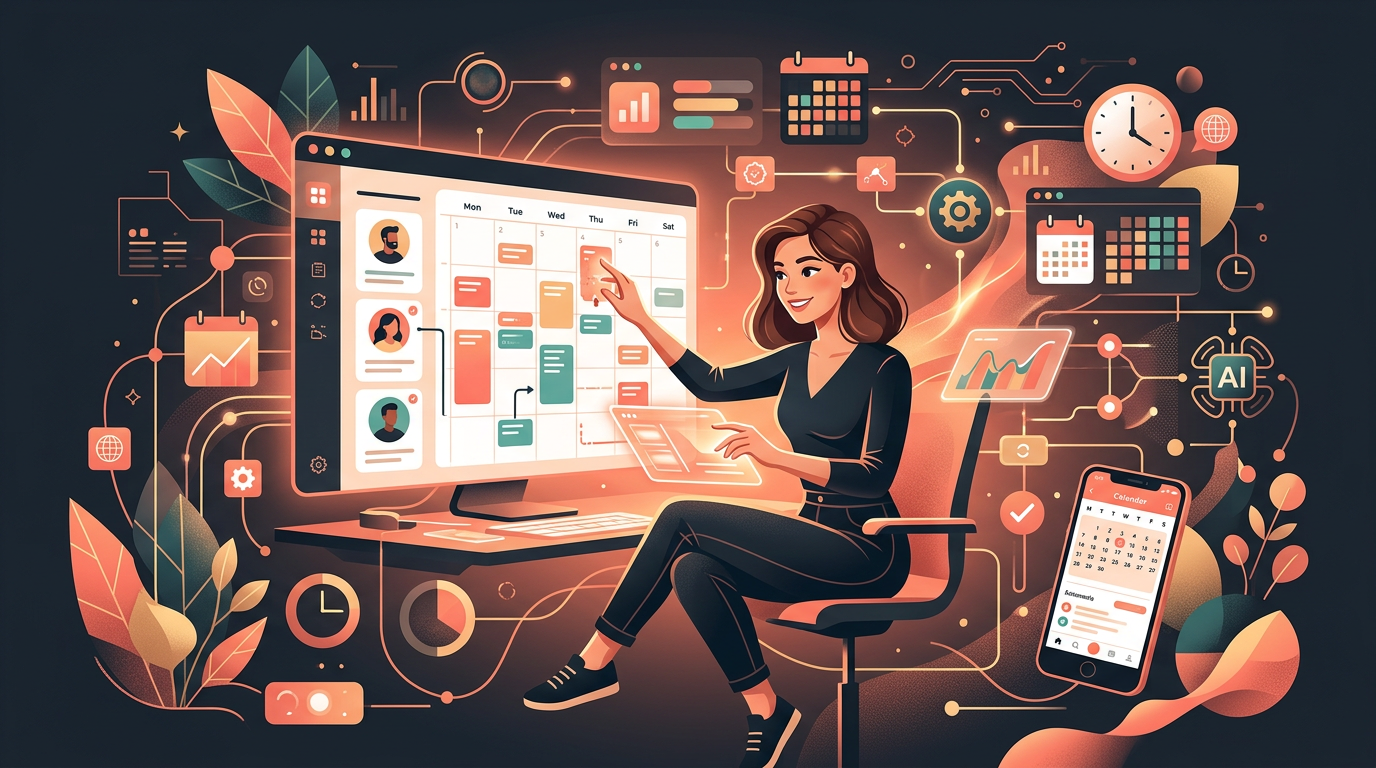
Reimagining Productivity Through AI Building
Traditional software development often feels like a gated garden where only those who speak the language of syntax and semicolons are allowed to play. However, the rise of large language models (LLMs) and intuitive no-code platforms has opened the door for a new generation of creators. If you have ever struggled to find an appointment slot or felt the friction of back-and-forth emails, you know that scheduling is more than a calendar event - it is a logistics puzzle. By building an intelligent scheduling app without coding experience, you are not just creating a tool; you are mastering the art of digital problem-solving.
This shift is fueled by a movement we call vibe coding. This approach prioritizes the vision, the user experience, and the "vibe" of the application over the technical minutiae of the underlying infrastructure. For many, vibe coding for women represents a bridge between creative intent and functional execution. It allows you to focus on how an app should feel and behave, while AI handles the heavy lifting of generation and logic loops. This guide will walk you through the process of building a sophisticated scheduling engine from scratch, leveraging the power of AI building and the support of a women-led vibe coding community.
The Concept: What Makes a Scheduling App Intelligent?
A basic scheduling tool simply records a date and time. An intelligent scheduling app understands context. It knows that a Monday morning meeting requires a buffer for deep work, that a client in a different timezone needs converted hours, and that certain types of appointments require specific preparation materials sent via email beforehand.
When we talk about building these systems without code, we are looking at three core layers:
- The Interface (Front-end): Where the user interacts, selects dates, and inputs information.
- The Logic (Back-end): The engine that checks availability, prevents double-booking, and handles time zones.
- The Intelligence (AI Layer): The component that can parse natural language requests (e.g., "Find an hour for a coffee chat next Thursday afternoon") and provide personalized recommendations.
Step 1: Defining Your Workflow and Requirements
Before touching a single tool, you must map out the user journey. Start by asking what problem you are solving that a standard calendar does not. Perhaps you are building a specialized tool for health coaches who need to gather intake forms before a session, or maybe a system for freelance designers to manage project discovery calls.
- Identify the user: Who is booking the time?
- Define the constraints: When are you available? What are the buffer times?
- Choose the integrations: Do you need to connect to Google Calendar, Outlook, or a CRM?
- Outline the automation: What happens after the booking is confirmed?
If you are new to these terms, our glossary provides a breakdown of common tech architecture language. Understanding the difference between an API and a Webhook will help you navigate the AI building process more effectively.
Step 2: Choosing Your No-Code Stack
To build without coding experience, you need a stack of tools that communicate with each other seamlessly. For an intelligent scheduling app, consider the following categories:
The Visual Builder
Tools like Bubble, Softr, or FlutterFlow allow you to drag and drop elements to create a beautiful user interface. These platforms allow you to define what the user sees - such as date pickers, profile pages, and confirmation screens.
The Logic Engine
Make (formerly Integromat) or Zapier act as the "glue" for your app. These platforms move data between different services. For example, when a user clicks "Confirm" in your app, Make can trigger an action that updates your calendar and sends a Slack notification simultaneously.
The AI Brain
This is where vibe coding truly shines. By using OpenAI's API or specialized AI agents, you can teach your app to interpret messy human input. Instead of a rigid form, your user could type, "I'm free next Wednesday between 2 and 4," and the AI will extract the data points needed to find a matching slot in your database.
Step 3: Leveraging Vibe Coding Principles
As you begin building, you will realize that your greatest asset is your ability to describe what you want clearly. This is the heart of vibe coding for women. Instead of getting frustrated by a bug in a line of code, you interact with AI builders by describing the desired outcome.
In the first women-led vibe coding community, we emphasize the importance of iterative prompting. You might start by telling an AI assistant, "Build me a database schema for a scheduling app with users, appointments, and time slots." If the result is too complex, you refine the prompt: "Simplify this to only include essential fields for a solo consultant."
This conversational approach to development lowers the barrier to entry significantly. You are essentially acting as the architect and creative director, while the AI functions as your lead developer.
Step 4: Building the AI Scheduling Logic
To make your app "intelligent," you need to implement a feature often called Natural Language Scheduling. Here is a hypothetical workflow for building this feature:
- Capture Input: Create a simple text area in your app where the user can type their request.
- Process with AI: Send that text to an LLM (like GPT-4) with a specific system prompt. You might tell the AI: "You are a scheduling assistant. Extract the date, start time, end time, and meeting topic from this text. Return the data in a clean format."
- Validate Availability: Use your logic engine (Make or Zapier) to check your connected calendar for conflicts.
- Confirm and Execute: The AI returns a suggested time. The user clicks "Accept," and the logic engine creates the calendar event and sends the invites.
This setup creates a premium experience that feels much more personal than a standard booking link. It demonstrates the power of being part of a women-led vibe coding community, where we share these specific "recipes" for automation and AI integration.
Step 5: Testing and Iteration
No app is perfect on the first try. Testing is where you refine the user experience. Invite a few friends to try and "break" the system. Do they find the instructions clear? Does the AI handle ambiguous dates like "next Tuesday" correctly?
During this phase, lean on our workshops for guidance on troubleshooting and UI/UX design. Often, a small change in the way you prompt your AI can fix a recurring logic error. This iterative process is what turns a simple project into a robust application.
Overcoming the "Imposter Gap"
One of the biggest hurdles when building without coding experience is the psychological one. Many women feel they aren't "techy" enough to build software. But vibe coding is changing that narrative. It rewards intuition, empathy, and clear communication - traits that many women already excel in.
By focusing on the "vibe" - the connection between the user and the tool - you are engaging in a sophisticated form of engineering. You are orchestrating complex systems to provide value. This is high-level tech work, even if you never manually wrote a single line of JavaScript.
Essential Features to Include
To ensure your intelligent scheduling app is competitive, consider adding these features:
- Automatic Time Zone Detection: Essential for global professional work.
- Multi-Calendar Sync: Checking both personal and professional calendars to avoid burnout.
- Conditional Logic Forms: Asking different questions based on the type of meeting selected.
- Automated Follow-ups: Sending a "thank you" or a recording link 24 hours after the meeting ends.
- Payment Integration: If you are a consultant, require payment via Stripe at the time of booking.
Practical Takeaways for Your AI Building Journey
- Start Small: Don't try to build the next Calendly on day one. Start with a tool that solves one specific scheduling pain point for you.
- Use Templates: Many no-code platforms offer templates for scheduling apps. Use them as a foundation and then layer on your AI intelligence.
- Focus on the Prompt: In vibe coding, your prompt is your code. Spend time learning how to communicate effectively with AI models to get the best results.
- Join a Community: Building in isolation is difficult. Connect with others who are on the same path through our community to exchange ideas and find encouragement.
The Power of a Women-Led Ecosystem
Being a part of the VibecodHER movement means you have access to resources tailored specifically for the feminine approach to technology. We prioritize community, aesthetic, and functional simplicity. When you build within this ecosystem, you aren't just getting technical advice; you are gaining a support system that understands the unique challenges and strengths of women in the AI space.
Building an intelligent scheduling app is just the beginning. Once you understand how to connect an interface to an AI brain, you can build almost anything. From personal CRM systems to automated content engines, the skills you learn while building a simple scheduler are transferable to much larger projects.
How long does it take to build a basic version?
You can typically have a functional MVP (Minimum Viable Product) ready in a weekend if you are using no-code tools and AI assistants. The logic for scheduling is straightforward, and the AI handles the complex language processing.
Do I need to pay for AI credits to run the app?
Most AI APIs (like OpenAI) operate on a pay-as-you-go model. For a low-volume personal scheduling app, the costs are usually very minimal. As your app grows and handles more users, the cost will scale with your usage.
Is vibe coding secure for professional use?
Yes, as long as you follow best practices for data privacy and security provided by your no-code platforms. Always ensure you are not passing sensitive personal information into an AI prompt without proper encryption or anonymization.
Do I need to know math or logic to build these apps?
You don't need advanced math, but you do need "if-then" logic. For example: "IF the user selects 'Consultation', THEN show them the payment screen." This type of logical thinking is inherent to how we organize our daily lives, making it very accessible.
Ready to start your journey into the world of AI building? Join the free VibecodHER community and connect with other creators who are reclaiming tech on their own terms. Whether you are building your first app or your tenth, there is a seat at the table for you in the first women-led vibe coding community.