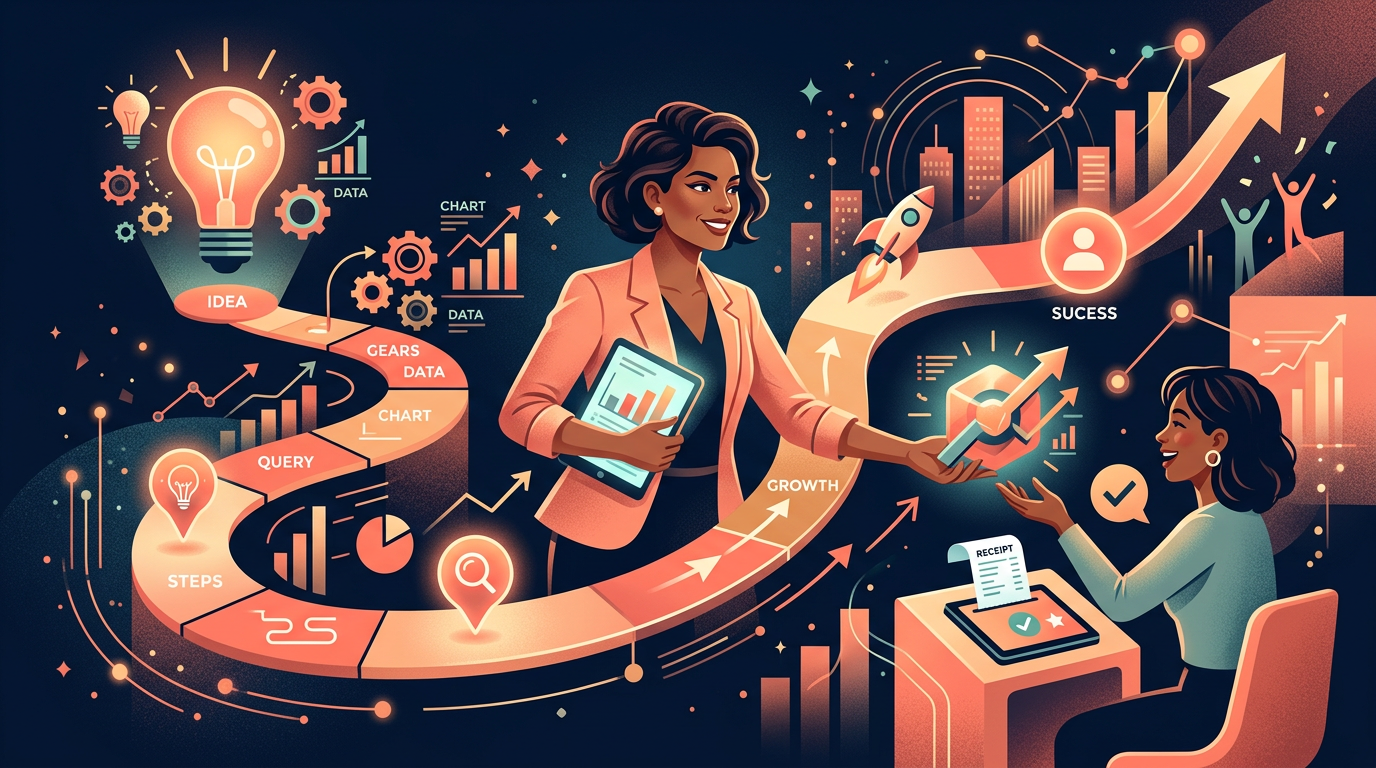
From Sketch to Sale: Bridging the Gap Between Vision and Revenue
Turning a brilliant spark of an idea into a tangible, revenue-generating reality is the ultimate challenge for any entrepreneur. For many women in tech and creative industries, the journey isn't just about writing lines of code or setting up a storefront; it is about finding a niche where innovation meets actual human needs. In the modern era, the barrier to entry has shifted. We are no longer limited by deep technical constraints, thanks to the rise of vibe coding for women, a movement that prioritizes intuition, language-based creation, and AI collaboration over traditional syntax-heavy programming.
Securing that first paying customer is a foundational milestone. It validates your hypothesis, confirms that someone values your solution enough to part with their hard-earned money, and provides the momentum needed to scale. This guide explores the strategic steps required to move from a raw concept to a successful transaction, leveraging the power of vibecodher and modern AI-driven workflows.
Phase 1: Validating the Concept Without Over-Engineering
The most common mistake early founders make is spending months building a polished product before ever speaking to a potential buyer. To move from idea to first paying customer quickly, you must embrace the concept of the Minimum Viable Vibe. This is where you test the core essence of your idea using conversational AI and low-code tools to see if the "vibe" resonates with your target audience.
Define the Pain Point
Before you build anything, you must identify a specific problem. Avoid broad generalities. Instead of saying "I want to help people manage time," try "I want to help freelance designers automate their client feedback loops." The more specific the pain point, the easier it is to find a customer willing to pay for the cure.
Rapid Prototyping with AI
You do not need a full development team to create a proof of concept. By utilizing the principles found in our glossary, you can use large language models and no-code builders to create a functional mock-up in a weekend. This allows you to show potential customers exactly what you are thinking, transforming an abstract idea into something they can interact with.
Phase 2: Building the Solution Through Vibe Coding
If you have identified a clear problem, the next step is building the solution. This is where many women feel intimidated, but the landscape has changed. We are seeing a massive shift toward accessible technology, and VibecodHER is proud to be the first women-led vibe coding community dedicated to making this transition seamless.
The Power of Vibe Coding for Women
Traditional coding requires learning complex languages like Python or JavaScript. While these are valuable, vibe coding for women focuses on using natural language to direct AI agents and builders to create software. This democratizes the building process. It allows you to focus on the user experience and the strategic "vibe" of the product rather than getting stuck on a missing semicolon. This approach shortens the time from idea to market significantly, ensuring you don't lose steam during the development phase.
Incremental Development
Start small. If your vision is a comprehensive project management suite, start by building a single, high-performing feature. Perhaps it is just an automated reporting tool or a specialized calendar integration. By launching a small, focused tool, you can gather feedback and iterate toward the larger vision while already generating revenue.
Phase 3: Finding Your Early Adopters
Your first customer is rarely a stranger who stumbles upon your website via a Google search. They are usually found within your existing networks or specialized digital spaces. Finding them requires a mix of vulnerability and targeted outreach.
Leveraging Community Networks
Being part of a women-led vibe coding community provides a safe space to test your pitch. Look for spaces where your target demographic hangs out. Join the community to find peers who can offer honest feedback or even become your first beta testers. Authentic engagement in these spaces often leads to organic discovery.
The Power of One-on-One Outreach
In the beginning, do things that do not scale. Send personalized messages to people who have expressed the pain point you are solving. This isn't about spamming; it is about starting a conversation. Ask them about their current workflow and show them how your tool can save them time or money. This high-touch approach is often what converts a curious lead into a first paying customer.
Phase 4: Nailing the Offer and the Price
Many women struggle with pricing their worth. When moving from idea to first paying customer, it is tempting to offer your product for free or at a deep discount. While beta testing is great, a "paying" customer is the only true form of validation.
Creating a Compelling Offer
Your offer is more than just the product. It is the support, the community, and the transformation you provide. When you present your solution, frame it in terms of ROI (Return on Investment). How much time are they saving? How much stress are they removing? If you are unsure how to frame this, consider attending one of our workshops to refine your business model and pitch.
Pricing for Traction
For your very first customer, consider a "founder's price" or a lifetime deal. This rewards them for taking a chance on an early-stage product while still ensuring a financial commitment. This commitment creates a different level of user engagement compared to free users - paying customers are more likely to provide high-quality feedback that helps you grow.
Phase 5: Closing the Sale and Collecting Feedback
Once you have a lead interested, you need to make the transaction as frictionless as possible. Use simple payment processors like Stripe or Lemon Squeezy. Do not worry about complex enterprise billing systems yet. Just focus on the exchange of value.
The Post-Purchase Interview
Immediately after someone pays, your job isn't over. This is the most critical time to gather data. Ask them:
- What was the specific moment you decided to buy?
- What was your biggest hesitation?
- What is the one thing you hope this tool does for you above all else?
This qualitative data is the roadmap for your future updates and marketing copy. It tells you exactly what resonated so you can repeat it for your second, tenth, and hundredth customer.
Actionable Takeaways for Your Launch Journey
To help you stay on track, here are the core steps to take this week:
- Day 1-2: Identify a singular, painful problem and write down exactly who has it. Use social media or forums to see if people are actively complaining about it.
- Day 3-4: Use AI to build a simple interactive prototype or landing page that explains the "vibe" and the solution.
- Day 5: Reach out to five people in your network or relevant communities and ask for 15 minutes to show them what you are building.
- Day 6-7: Ask for the sale. If they say no, ask why. Use that feedback to pivot or refine your offer.
Remember, your first product doesn't have to be perfect; it just has to be useful. The goal is to prove that your idea has market legs. By utilizing AI and participating in a supportive environment like a women-led vibe coding community, you can bypass the traditional hurdles that often stop great ideas in their tracks.
Frequently Asked Questions
What if I don't have a technical background?
This is the beauty of the current era. With vibe coding, your ability to describe a solution and understand user needs is more important than your ability to write manual code. Tools are now designed to translate your vision into functional applications through natural language instructions.
How do I know if my idea is actually good or if people are just being nice?
The only real proof is a transaction. People will be polite if you ask for their opinion, but they will be honest when you ask for their credit card. Aim for the "ask" early to get the most truthful data possible.
Is vibe coding for women different from regular AI content?
Yes. Vibe coding is specifically about building functional software, websites, and digital tools through the lens of aesthetic and functional "vibes." It combines technical execution with creative intuition, making it an empowering path for women who want to build tech without the high-friction entry of traditional computer science.
How much should I charge my first customer?
Start with a price that feels slightly uncomfortable but fair. Look at what they are currently spending to solve the problem (even if they are "spending" time). If your tool saves them five hours a week, what is that worth to them? Pricing is a subjective value exchange, not just a calculation of your costs.
Where can I find support during this process?
Entrepreneurship can be lonely, but it doesn't have to be. Joining a community of like-minded builders can provide the accountability and technical help you need to keep going. Join the free VibecodHER community to connect with other women who are moving from idea to launch right now.