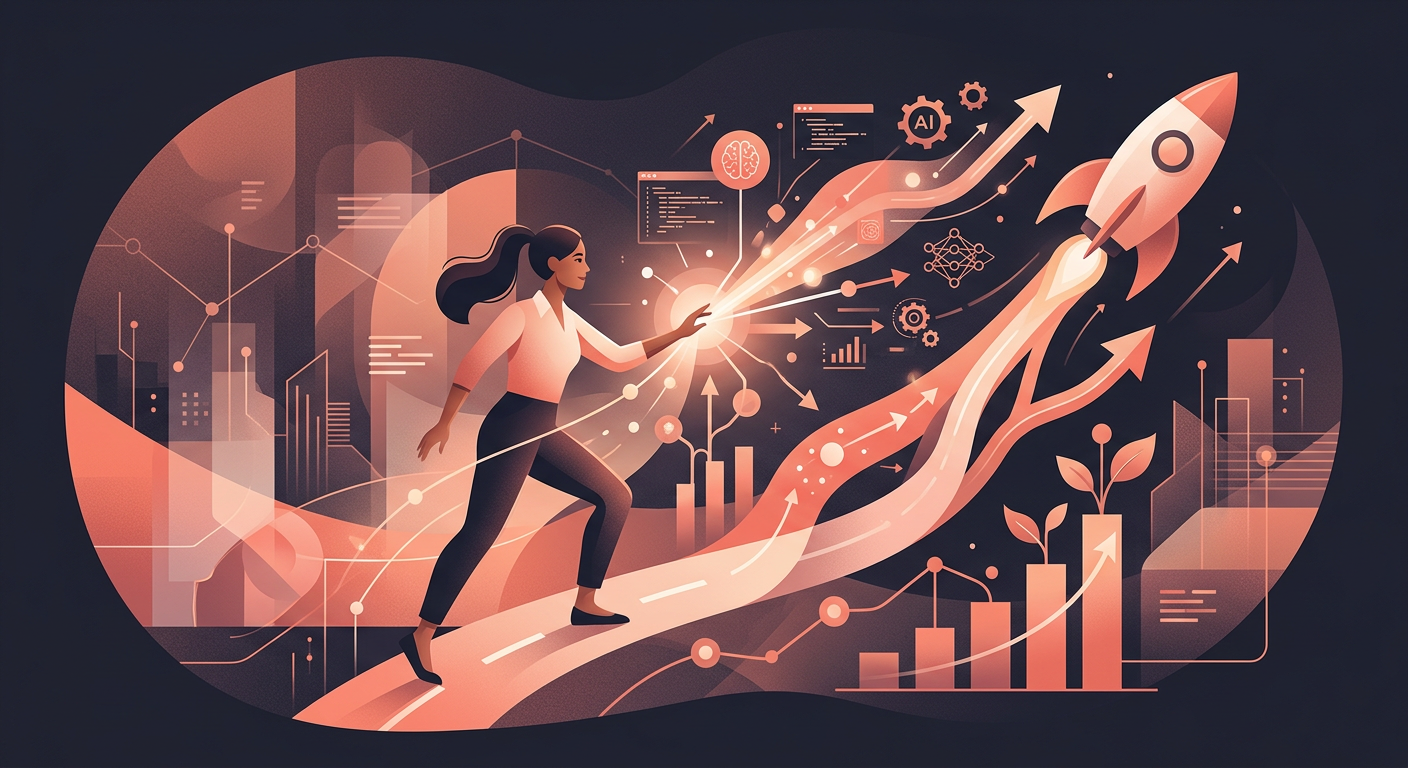
Building an AI application is no longer the insurmountable technical hurdle it once was. With the rise of Large Language Models (LLMs) and intuitive development interfaces, women are launching sophisticated tools in record time. However, the true challenge has shifted from construction to distribution. If you have built something incredible using modern AI tools, the next step is growth hacking your AI-built product to ensure it reaches the hands of those who need it most.
Growth hacking is not just about aggressive marketing. It is the intersection of product development, data analysis, and creative experimentation. For the modern female entrepreneur, this means leveraging the speed of AI to test hypotheses faster than traditional startups ever could. By integrating growth mechanisms directly into your software, you create a self-sustaining engine of acquisition and retention.
The Shift to Vibe Coding for Growth
Traditional software development often feels clinical and disconnected from the end-user. This is where vibe coding for women changes the game. Vibe coding is the practice of focusing on the intent, user experience, and aesthetic flow of an application while letting AI handle the heavy lifting of the syntax. When you apply this philosophy to growth hacking, you focus on the "vibe" of your product's virality.
Instead of just building features, you are building emotional resonance. Does the user feel empowered when they use your tool? Does the interface invite them to share their results? Growth hacking your AI-built product requires you to look at the glossary of modern tech terms and redefine them through the lens of user delight. When the vibe is right, users become advocates naturally, reducing your customer acquisition cost (CAC).
Viral Loops: Building Shareability into the Core
A common mistake in AI product launches is treating marketing as a separate entity from the product. To scale efficiently, growth must be baked into the code. Consider how your AI can generate shareable moments. If you are building a generative design tool, can the user export a beautifully branded summary of their creation with one click?
This is a fundamental pillar of vibecodher, where we focus on creating products that speak for themselves. Viral loops function best when they provide value to both the sender and the receiver. For example, an AI-powered writing assistant might offer extra credits to a user who invites a collaborator, or a project management AI could offer advanced templates when a user shares their workflow to a public gallery.
Types of Viral Loops for AI Products
- Incentivized Referrals: Giving users more API tokens or premium features for successful sign-ups.
- Content Loops: Automatically creating SEO-friendly public pages for user-generated content.
- Collaborative Loops: Features that require a second user to participate, naturally expanding the user base.
Leveraging AI for Rapid Experimentation
The most significant advantage of an AI-built product is the ability to iterate at lightning speed. Growth hacking is essentially a series of experiments. You hypothesize that a certain landing page headline will convert better, you test it, and you analyze the data.
With AI, you can generate ten different variations of a landing page or a feature set in the time it used to take to write one. Use AI to analyze user feedback from your community and immediately feed those insights back into your build. This rapid feedback loop is what allows small, women-led teams to compete with massive corporations. You are not just building; you are evolving based on real-time market signals.
The Power of a Women-Led Vibe Coding Community
Scale does not happen in a vacuum. One of the most effective growth hacks is finding your tribe early. VibecodHER stands as the first women-led vibe coding community, providing a space where builders can cross-pollinate ideas and support each other's launches.
When you launch your AI-built product within a supportive ecosystem, you gain access to an immediate beta-testing group and a collection of early adopters who understand the vision. Community-led growth is more sustainable than paid advertising because it is built on trust and shared values. By engaging with other creators, you can discover co-marketing opportunities, such as bundling your AI tool with another complementary service, which introduces your product to a pre-qualified audience.
Technical SEO as a Growth Engine
While social media virality is exciting, search engine optimization (SEO) remains a powerhouse for long-term growth. Growth hacking your AI-built product involves ensuring that your site is technically sound and content-rich. Use AI to help you identify niche keywords that your competitors are overlooking.
Focus on creating high-value content that answers the specific questions your target audience is asking. If your AI tool solves a problem in the fashion industry, your blog should be the ultimate resource for tech-forward fashionistas. Referencing your internal resources like workshops can also help guide users deeper into your ecosystem, increasing their lifetime value (LTV).
Data-Driven Decision Making
You cannot hack what you do not measure. A successful growth strategy requires a deep dive into your analytics. You should be tracking:
- Activation Rate: How many people who sign up actually perform the core action of your AI tool?
- Retention Rate: Are users coming back after their first session?
- Referral Rate: How many new users are brought in by existing ones?
If you notice a drop-off in the activation phase, it might be a sign that your user onboarding is too complex. Use your AI to simplify the process. Perhaps the AI can pre-fill certain fields or provide a guided walkthrough based on the user's specific goals. Small tweaks in the user journey can lead to massive improvements in growth metrics.
Actionable Steps for Growth Hacking
To begin growth hacking your AI-built product today, follow these practical steps:
- Identify your North Star Metric: Choose one metric that best represents the value your product provides. Focus all your growth experiments on moving this number.
- Optimize Your Onboarding: Ensure the time-to-value (TTV) is as short as possible. The user should experience the "magic" of your AI within the first sixty seconds.
- Implement Social Proof: Use AI to aggregate and display testimonials or live usage statistics on your landing page to build immediate credibility.
- Create an Affiliate Program: Empower your most loyal users to become partners in your growth by offering them a stake in the revenue they help generate.
- Host a Virtual Event: Use workshops to educate your audience on how to get the most out of your tool. Education is a powerful top-of-funnel growth strategy.
Overcoming the Perfectionist Trap
Many women in tech struggle with the desire to have a perfect product before they start growth hacking. In the world of AI, perfection is the enemy of progress. The technology is moving so fast that waiting six months to launch a "perfect" feature might mean the market has already moved on.
Embrace the "vibe" and launch early. Growth hacking is about learning from the market and adjusting. Your users will tell you what they want if you give them the chance to use a functional version of your vision. The beauty of vibe coding is that you can build, break, and rebuild in a fraction of the time it takes for traditional coding methods.
Conclusion: Scaling with Intention
Growth hacking your AI-built product is an empowering journey that combines technical skill with strategic creativity. By focusing on viral loops, community engagement, and rapid experimentation, you can scale your application without needing a massive marketing budget. Remember that you are not just building software; you are building a solution that reflects your unique perspective.
As you continue to refine your product, lean on the resources available to you. Whether it is looking up technical terms in the glossary or attending workshops to sharpen your skills, continuous learning is the ultimate growth hack. You have the tools, the vision, and the community to make a significant impact in the tech world.
How do I know if my AI product is ready for growth hacking?
Your product is ready for growth hacking when you have achieved "minimum viable delight." This means that while you may still have features to add, the core functionality of your AI tool provides genuine value and a positive experience for the user. If your early testers are returning to the tool and recommending it to others, it is time to scale.
What are the best low-cost growth hacks for AI startups?
Content marketing and community building are the most effective low-cost strategies. By providing valuable insights and participating in a women-led vibe coding community, you build authority and trust. Additionally, leveraging "Engineering as Marketing"-where you create a free, simplified version of your tool to attract leads-can be highly effective.
How does vibe coding differ from traditional development in terms of growth?
Vibe coding allows for a much faster iteration cycle. In traditional development, a growth experiment might require weeks of backend changes. With vibe coding, you can describe the desired change to your AI assistant and implement new growth features or landing pages in hours. This speed is a significant competitive advantage when testing growth hypotheses.
How can I keep users engaged with my AI tool long-term?
Long-term engagement, or retention, is driven by continuous value. Use AI to personalize the user experience, providing tailored suggestions or reports based on their specific usage patterns. Regularly updating your product with new features and maintaining an active community presence also keeps your tool top-of-mind for your users.