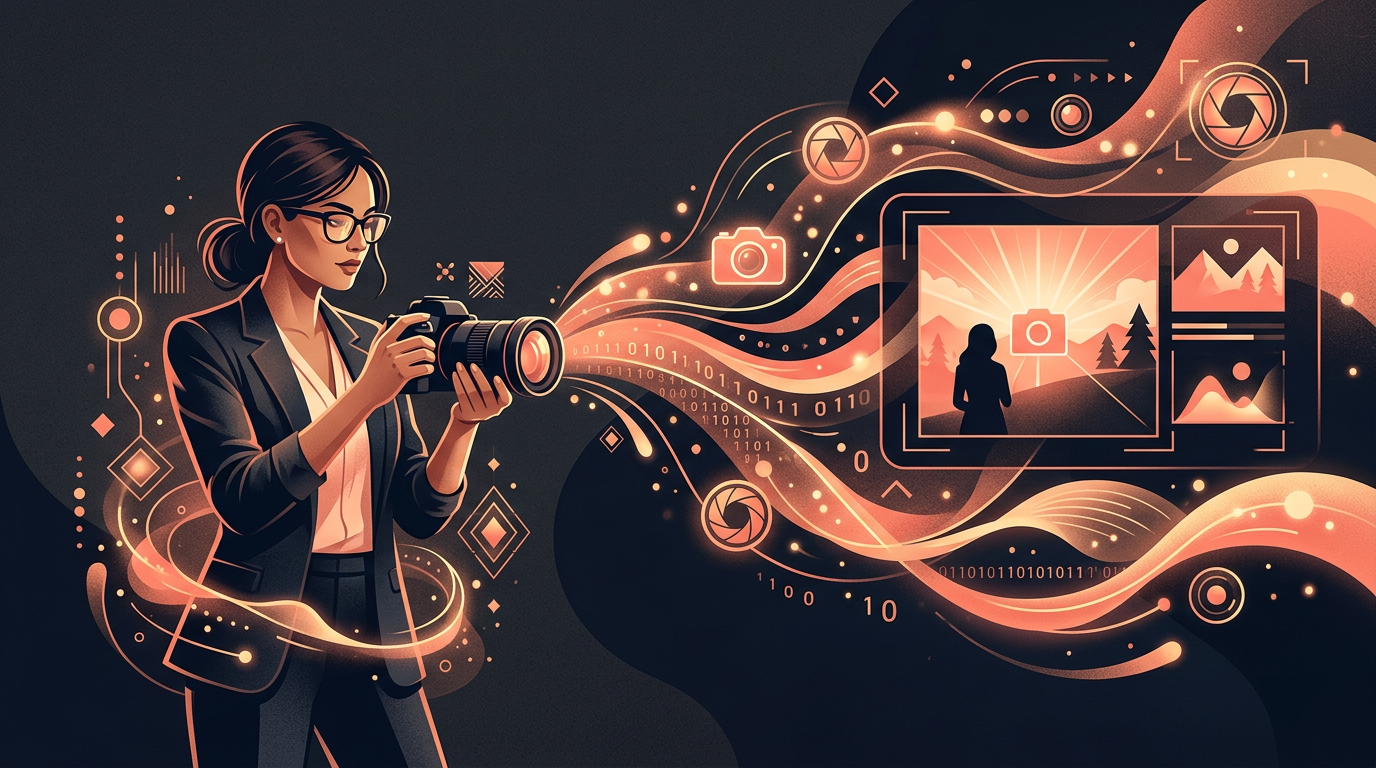
The world of professional photography is undergoing a seismic shift. For decades, the barrier between artistic vision and technical execution was defined by expensive software suites and hours of manual labor. Today, a new movement is emerging that allows photographers to bypass traditional development hurdles entirely. This movement is called vibe coding. By articulating a desired outcome through natural language and intuitive logic, visual artists are now building their own custom software solutions without ever typing a line of syntax.
Learning how photography professionals are using vibe coding reveals a broader trend: the democratization of software creation. For women in the creative arts, this represents a unique opportunity to build tools that prioritize aesthetic sensibility and workflow efficiency. As the founder of VibecodHER, the first women-led vibe coding community, I have seen firsthand how shifting the focus from syntax to sentiment empowers creators to own their tech stack.
Understanding Vibe Coding in the Visual Arts
To understand the impact on photography, we must first define the core concept. Vibe coding is the practice of using high-level prompts, AI agents, and natural language to generate functional code and applications. Instead of studying Python or C++, a photographer describes the "vibe" or the specific logic of the tool they need. If you are new to these terms, checking our glossary can help you ground your understanding in the latest terminology.
Photography has always been a blend of the technical and the soulful. Vibe coding bridges this gap. It allows a photographer to say, "Build me a script that scans my metadata, identifies photos with a specific warm color profile, and moves them into a 'Golden Hour' folder for my editor," and have that tool manifest instantly. This isn't just about automation; it is about building software that feels like an extension of the artist's eye.
Custom Workflow Automations for High-Volume Shooters
One of the most significant ways photography professionals are using vibe coding is through the creation of bespoke workflow automations. High-volume photographers - such as wedding or event shooters - often find themselves trapped in the repetitive tasks of culling, renaming, and filing.
Intelligent Culling Tools
Imagine a photographer who feels that existing AI culling software is too aggressive or lacks the "feeling" they look for in an image. Using vibe coding, they can build a custom agent that looks for specific emotional cues. They might prompt a vibe coding environment to create a tool that prioritizes images where subjects are laughing or where the lighting hits the lens at a specific angle. This level of customization ensures that the software understands the photographer's unique artistic DNA.
Asset Management and Client Delivery
Standard gallery platforms can be rigid. Photography professionals are now vibe coding their own mini-apps to handle client previews. These apps can be tailored to specific projects - perhaps a gallery that changes its interface color based on the dominant hex codes in the photos, creating a cohesive atmospheric experience for the client. By visiting our workshops, you can learn the fundamental building blocks of creating these types of custom interfaces.
Vibe Coding for Women: Why the Creative Perspective Matters
Historically, the tools used by photographers were built by engineers who may not have understood the nuance of a creative workflow. Vibe coding for women offers a pathway to change this narrative. Women often approach technology through the lens of problem-solving and community-building, which makes them natural vibe coders.
By focusing on the "vibe" - the essence, the feel, and the user experience - women photographers are crafting tools that are more intuitive and less clinical. This shift is a core pillar of the /vibecodher initiative, where we prioritize the human element of software development. When a photographer builds their own tool, they aren't just saving time; they are reclaiming the sovereignty of their creative process.
Enhancing Post-Processing and AI Integration
Post-processing is often the most time-consuming part of being a professional. Vibe coding allows photographers to create custom "middleware" that connects their favorite editing software with new AI models.
- Prompt-to-Preset Generation: Photographers are vibe coding tools that take a mood board or a descriptive paragraph (e.g., "1970s film style with a heavy grain and muted greens") and automatically generate a starting point for their color grading.
- Batch Retouching Filters: Instead of relying on generic filters, a pro can vibe code a script that identifies specific skin tones or textures within a batch of 500 images and applies a consistent, subtle correction that respects the original lighting.
- Metadata-Driven SEO: For commercial photographers, SEO is vital. Professional photographers are using vibe coding to build tools that scan their images for content and auto-generate highly specific, localized alt-text and metadata, saving hours of manual data entry.
Building Niche Micro-SaaS for the Photo Industry
Some photography professionals are going beyond personal use and creating small software products for their peers. This is the beauty of the women-led vibe coding community; it fosters an environment where an individual's solution to a problem can become a tool for many.
Consider a photographer who specializes in food styling. They might vibe code a specialized "Nutrition Label Generator" that overlays macro data onto their images for social media clients. This tool, built in an afternoon through vibe coding, could be turned into a subscription service for other food photographers. The transition from artist to developer is no longer a multi-year journey - it is a series of conversations with an AI agent.
Actionable Steps to Start Vibe Coding Today
If you are a photography professional looking to integrate these techniques into your studio, follow these practical steps:
- Identify the Friction: Keep a log for one week. Every time you perform a repetitive digital task (like renaming files or resizing for different social platforms), write it down. These are your prime candidates for vibe coding.
- Describe the Outcome, Not the Process: When you start building, don't worry about how the code should look. Focus on describing what the end result should be. Use phrases like "I want a button that..." or "When a file is uploaded, do X, Y, and Z."
- Use Modular Building: Start small. Don't try to build a full Lightroom competitor. Start by building a tool that performs one specific task perfectly. You can see examples of these modular builds within our community.
- Iterate with Feedback: The power of vibe coding is the speed of iteration. If the first version of your tool isn't quite right, simply tell the AI what is wrong (e.g., "This is too slow" or "The colors are too saturated") and let it refine the logic.
The Role of Community in Technical Evolution
Learning in a vacuum is difficult. The most successful photographers adopting vibe coding are those who share their prompts, their logic, and their failures. Being part of the first women-led vibe coding community ensures that you have access to a support system that speaks your language. We look at software development not as a competition, but as a collaborative art form.
By engaging with others in the community, you can discover pre-built "vibes" or prompt structures that have already been tested by other visual professionals. This collective intelligence accelerates everyone's growth and ensures that the future of photography tech is built by photographers themselves.
Conclusion: The Future is Built by the Visionaries
Photography professionals who embrace vibe coding are moving from being passive consumers of technology to active creators of it. The ability to manifest custom tools on the fly is a competitive advantage that goes far beyond simple efficiency. It allows for a level of creative expression that was previously locked behind a wall of code.
As we continue to grow the VibecodHER movement, we invite you to explore how your unique vision can be translated into the digital tools of tomorrow. Whether you want to automate your studio, build an AI assistant, or launch a micro-SaaS, the barrier to entry has finally disappeared.
Join the free VibecodHER community
FAQ: Vibe Coding for Photographers
Do I need to know any programming languages to start vibe coding?
No. The essence of vibe coding is using natural language to communicate with AI. While understanding basic logic is helpful, you do not need to write Python, Javascript, or any other traditional language. You simply need to be able to describe your desired outcome clearly.
What are some common tools used for vibe coding?
Photography professionals often use platforms like Replit, Cursor, or even simple no-code tools connected to LLMs (Large Language Models) like Claude or GPT-4. These environments allow you to "chat" with the codebase and see changes in real-time.
Is vibe coding better than using commercial photography software?
It is not always about being "better," but about being more specific. Commercial software is built for the average user. Vibe coding allows you to build features that are 100% tailored to your specific niche, which commercial software might never prioritize.
Can vibe coding help me make more money as a photographer?
Yes, in two ways. First, it increases your efficiency, allowing you to take on more clients or spend more time on billable creative work. Second, it allows you to create unique products or services - like custom apps or specialized AI tools - that you can sell to other photographers or clients.
How long does it take to build a basic tool with vibe coding?
For a simple automation, like a file organizer or a metadata tagger, a functional version can often be built in 15 to 30 minutes. More complex applications might take a few hours of iterative conversation with the AI agent.
Ready to take the next step in your tech journey? Join the free VibecodHER community and connect with other women building the future of creative technology.