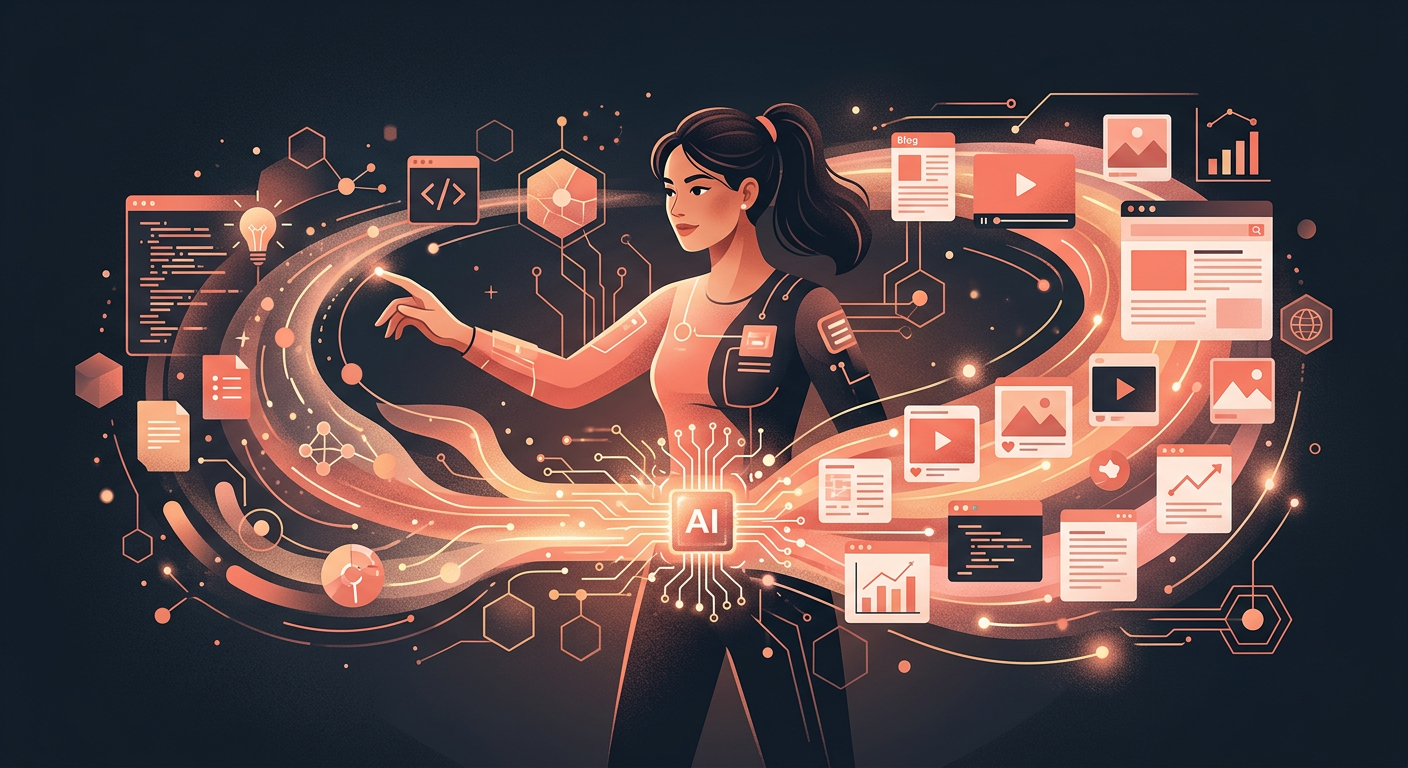
The Shift Toward AI Powered Content Systems
The way we build on the internet is changing rapidly. For years, content creation was a manual, often grueling process of staring at a blinking cursor. Today, we are entering the era of the autonomous creator. If you want to know how to use AI to automate content creation, you have to look beyond simple prompt engineering. You have to look at systems design.
At Kacibrown.co, we focus on the intersection of AI building and human creativity. We call this vibe coding. It is the practice of using high level natural language to guide powerful AI models into creating complex outputs. When applied to content, vibe coding allows you to stop being the writer and start being the editor-in-chief of your own automated media empire.
Automating content is not about flooding the internet with low quality noise. It is about leveraging Large Language Models (LLMs) to handle the heavy lifting of research, formatting, and drafting so you can focus on the unique insights only you can provide. By the end of this guide, you will understand how to build a content engine that works while you sleep.
Understanding the Architecture of an AI Content Engine
To effectively use AI for content, you must stop thinking about single prompts and start thinking about workflows. A successful automation stack usually consists of three distinct layers:
- The Brain (LLMs): This is where the actual generation happens. Tools like GPT-4, Claude 3.5 Sonnet, or Llama 3 act as the engine that processes information and generates text.
- The Nervous System (Automation Tools): This involves platforms like Zapier, Make.com, or custom Python scripts that move data between apps. These tools connect your AI brain to your CMS, social media, and email lists.
- The Memory (Knowledge Base): This is your context. By using a glossary of terms and a database of your previous work, you ensure the AI maintains your specific voice and expertise.
When these three layers work in harmony, you transition from manual labor to architectural oversight. You are no longer just writing a blog post; you are building a system that produces them.
Stepping Into Vibe Coding for Content
If you have explored our vibecodher resources, you know that vibe coding is about intention. When automating content, your "vibe" is your brand voice. To automate this, you must define your parameters clearly.
Imagine a scenario where you want to turn a single YouTube video into a week's worth of social media posts. A manual creator would spend hours transcribing and rewriting. A vibe coder builds a pipeline. You provide the AI with a transcript, a set of brand guidelines, and a specific output format. The AI then handles the extraction of key points, the drafting of threads, and the generation of image prompts.
Define Your Content Pillars
Before you touch an AI tool, you need to know what you stand for. Your content pillars are the foundation of your automation. If your pillars are AI building, productivity, and women in tech, every automated output should be gated against these themes. This prevents the AI from hallucinating or drifting into generic territory.
Essential Workflow: From Idea to Multi-Channel Distribution
Learning how to use AI to automate content creation requires a repeatable process. Here is a high-level workflow used by many advanced AI builders:
1. Data Ingestion and Research
Automated content starts with an input. This could be a specialized RSS feed, a transcript of a meeting, or a raw brain dump in a voice memo app. Using tools like Whisper for transcription allows you to capture your authentic voice without typing a single word.
2. The Multi-Step Prompting Chain
Never ask an AI to "write a 2,000-word blog post" in one go. The quality will be mediocre. Instead, use a chain:
- Step A: Generate a detailed outline based on the research.
- Step B: Research specific statistics or citations for each subheading.
- Step C: Draft each section individually to maintain high information density.
- Step D: Run a recursive pass to check for tone consistency and flow.
3. Human-in-the-Loop Refinement
This is where many creators fail. They remove the human entirely. To maintain authority, you must act as the final filter. This is a core tenant we teach in our workshops. You should spend 20% of the time editing the 80% of the work the AI completed. Look for "AI-isms" - those generic phrases that lack personality - and replace them with your own anecdotes.
Tools to Fuel Your Automation Stack
While the strategy matters more than the tool, having the right stack is vital. Here are the categories of tools you should consider:
- Writing and Ideation: Claude for creative nuance, GPT-4o for logic and data processing.
- Visuals: Midjourney or DALL-E 3 for generating featured images and social assets that match your brand aesthetic.
- Orchestration: Make.com is often preferred over Zapier for complex content workflows because it allows for more granular logic and error handling.
- Content Management: Notion or Airtable act as excellent hubs to store your automated drafts before they go live.
Scaling Your Presence with the VibecodHER Method
Becoming a leader in the tech space requires more than just technical skill; it requires a visible presence. For many women in tech, the barrier to entry is the time required to maintain that presence. By mastering the art of AI building, you remove that barrier.
When you use AI to automate your content, you are essentially cloning your expertise. You can be active on LinkedIn, Twitter, and your personal blog simultaneously without burning out. This isn't just about efficiency; it's about impact. The more you share your knowledge, the more you contribute to the community.
Actionable Steps to Get Started Today
- Audit your manual tasks: List every step you take to publish a piece of content. Which of those steps requires your unique creativity, and which are just formatting or summarizing?
- Build a small-scale automation: Start by automating one small thing, like turning your blog posts into three LinkedIn updates using a simple Make.com scenario.
- Develop your style guide: Create a document that defines your tone (e.g., professional, witty, rebellious) and feed this into your AI prompts as a system message.
- Experiment with different LLMs: Don't settle for one. You might find that one model is better at writing technical tutorials while another excels at punchy social copy.
Overcoming the Quality Gap
The biggest criticism of AI content is that it feels "robotic." You can avoid this by injecting personal data. Use your specific experiences and failures as the "seed" for your AI generations. If the AI doesn't know your story, it can't tell it. By providing specific context in your prompts, you ensure the output stays grounded in reality and provides actual value to your readers.
Remember, AI is a tool for leverage, not a replacement for your perspective. The goal is to spend less time on the "how" of writing and more time on the "what" and "why" of your message.
Frequently Asked Questions
Does AI-generated content hurt my SEO rankings?
Search engines generally prioritize high quality, helpful weight regardless of how it was produced. As long as your automated content provides genuine value, answers user questions, and avoids repetitive spamming, it can rank very well. The key is the human-in-the-loop editing process to ensure accuracy and engagement.
How do I maintain a consistent brand voice across different AI tools?
Consistency is achieved through a centralized Brand Identity Document. You should include your brand's mission, preferred vocabulary, and tone of voice. Feed this document into the "System Instructions" or "Knowledge Base" of whatever AI tool you are using. This ensures that whether you are using Claude or GPT, the output feels like it came from the same person.
Do I need to know how to code to automate my content?
Not necessarily. While knowing Python or JavaScript allows for deeper customization, no-code tools like Make.com and Zapier have made it possible for anyone to build complex AI workflows. This is the essence of vibe coding: using logic and natural language to build systems without needing to be a software engineer.
How much time can I actually save with AI content automation?
While it varies by the complexity of the content, many creators report a significant reduction in the hours spent on first drafts and distribution. Instead of spending ten hours a week on social media and blogging, you might spend two hours managing the system and fine-tuning the outputs. This frees you up to focus on higher level strategy and community building. If you are ready to stop being a slave to the content treadmill and start building systems that grow your brand, come join our tribe. We discuss these workflows, share prompt recipes, and support each other in the journey of AI building. Join the free VibecodHER community
Join the First Women-Led Vibe Coding Community
If you're a woman in vibe coding - or curious about getting started - VibecodHER is built for you. We're the first women-led vibe coding community where women ship real apps and AI products together. Join the free VibecodHER community on Skool and start building today.