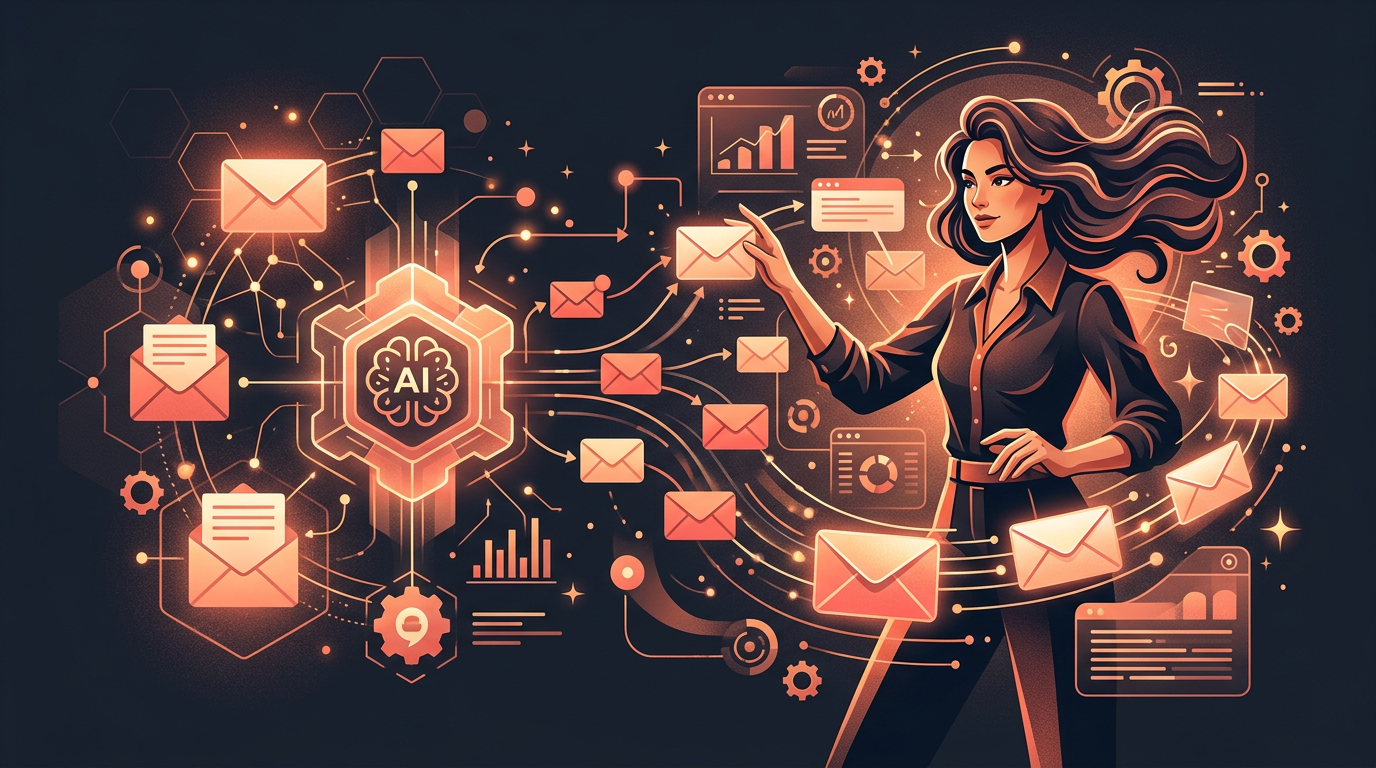
How to Use AI to Automate Email Follow-Ups
Efficiency is the new currency for women in tech and entrepreneurship. We are often juggling product development, community building, and personal growth all at once. In this environment, the follow-up manual labor often becomes a bottleneck. We know that the magic happens in the follow-up, yet it is the first thing to slip through the cracks when our calendars get crowded.
Learning how to use AI to automate email follow-ups is not just about saving a few minutes each day. It is about reclaiming your mental bandwidth so you can focus on high-level strategy and creative vision. By leveraging Large Language Models (LLMs) and intelligent automation workflows, you can ensure that no lead, partner, or community member ever feels forgotten.
At kacibrown.co, we believe in the power of vibe coding for women, which blends the technical logic of AI with the intuitive, aesthetic, and emotional intelligence that women bring to the table. When you automate your emails with a "vibe-first" mindset, your messages do not sound like robots - they sound like a more organized version of you.
Why AI Changes the Follow-Up Game
Traditional email automation relied on rigid sequences. You would write a Template A, set a three-day delay, and send Template B. The problem is that these templates often lack context. If a lead replied with a specific question on day two, the automated follow-up on day three would often feel disjointed or even rude.
AI changes this by introducing dynamic context. Instead of a static script, AI can analyze the previous conversation, understand the intent of the recipient, and generate a response that feels personalized and timely. This is a core component of vibe coding: using technology to enhance human connection rather than replace it.
Step 1: Defining Your Follow-Up Logic
Before touching a single AI tool, you must define your logic. Automation without a roadmap is just a faster way to create chaos. Consider your typical user journey. Are you following up on a sales inquiry, a networking request, or a community onboarding message?
- Trigger: What starts the process? (e.g., a new lead in your CRM, a tagged email in Gmail, or a new member joining your community).
- Condition: Under what circumstances should the AI wait or stop? (e.g., if the person has already replied, do not send the automated follow-up).
- Vibe: What is the tone? Should it be professional and authoritative, or warm and casual? Referencing our glossary can help you define these tonal parameters for your AI prompts.
Step 2: Choosing Your AI Tech Stack
To effectively automate your follow-ups, you need a bridge between your email provider and your AI engine. Here are the most common tools used in the women-led vibe coding community to get the job done:
- OpenAI (GPT-4o) or Anthropic (Claude): These are the brains of the operation. They generate the actual text of your follow-ups.
- Make.com or Zapier: These are the "connectors." They listen for a trigger in your email and send the data to the AI.
- Gmail or Outlook: Your delivery systems.
- Airtable: Often used as a "brain" or database to store contact history and custom context about each person you are emailing.
For those who want to dive deeper into building these specific connections, our workshops provide hands-on training for constructing these exact workflows from scratch.
Step 3: Writing High-Context AI Prompts
One of the most important skills in vibe coding for women is prompt engineering. A generic prompt like "Write a follow-up email" will yield a generic result. To make AI work for you, you must provide it with "anchors."
Example Prompt Structure:
"You are an expert communicator for a women-in-tech platform. I am going to provide you with a previous email exchange between me and [Name]. Your goal is to write a short, warm follow-up email. The goal is to see if they had any questions about our last session. Refer to the specific topic mentioned in their last message: [Insert Topic]. Keep it under three sentences and ensure it sounds encouraging and not pushy.”
By feeding the AI the context of the previous message, the automation becomes invisible. The recipient feels seen and heard.
Step 4: Building the Automation Workflow
If you are using a tool like Make.com, your workflow might look like this:
- Module 1 (Gmail): Watch emails. Trigger when a specific label (like "Follow Up") is applied to a thread.
- Module 2 (OpenAI): Send the text of the email thread to GPT-4o with the prompt we designed in Step 3.
- Module 3 (Gmail): Create a draft in Gmail with the AI-generated response.
We recommend starting with "Draft" mode rather than "Send" mode. This allows you to review the AI's work, add a final human touch, and then hit send. As you become more confident in your vibe coding skills, you can move toward fully autonomous sending for certain low-stakes categories.
How to Maintain your "Vibe" While Automating
One of the biggest fears women have about AI is losing their authentic voice. To prevent your automated emails from feeling cold, incorporate your unique vocabulary and values into your AI system. VibecodHER, the first women-led vibe coding community, emphasizes that your personality is your greatest competitive advantage in a world of generic AI content.
- Inject your slang: If you always say "Cheering for you" instead of "Best regards," make that a hard rule in your AI instructions.
- Set boundaries: Tell the AI to never use corporate jargon like "synergy" or "leverage" if that doesn't fit your brand.
- Use personal data: If your database knows the recipient's favorite hobby or their specific business goals, pass that data to the AI so it can mention it naturally.
Monitoring and Iteration
Automation is not a "set it and forget it" task. It is a living system. Every week, review the emails your AI has generated. Ask yourself:
- Did the AI misunderstand the tone of a reply?
- Were the follow-ups too frequent or too sparse?
- Did people engage more or less after the automation was implemented?
Refining your process is a continuous journey. You can learn more about these iterative cycles in our workshops, where we breakdown how to debug your AI's logic when the "vibe" feels off.
The Power of the Human-AI Loop
Automating your email follow-ups doesn't mean you are stepping away from your business. It means you are using AI as an extension of your own capabilities. Imagine a world where every potential collaborator gets a thoughtful, personalized check-in from you, exactly three days after your initial meeting, without you ever having to look at your calendar.
This is the promise of AI for the modern woman in tech. It allows us to scale our empathy and our reach without burning out. When we master these tools, we stop being the engine and start being the architect.
Actionable Takeaways for Your First Automation
- Start Small: Choose one specific type of email to automate (e.g., following up after a discovery call).
- Use Drafts First: Always have the AI save the response as a draft for the first 30 days to ensure it captures your voice.
- Identify Your Triggers: Decide exactly when a follow-up is necessary so the AI doesn't become "spammy."
- Join a Community: Don't build in a vacuum. Surround yourself with others who are experimenting with these same tools.
If you want to see how other women are building these systems and learn the latest techniques in AI design, there is no better place than our global network.
Join the free VibecodHER community
How does AI know when not to send a follow-up?
AI tools can be programmed to check for a "reply" status in your email thread. If a response is detected from the recipient within the specified timeframe, the automation logic can be set to terminate or move to a different branch, ensuring you don't send a redundant follow-up.
Will my emails get flagged as spam if I use AI?
Not if you use a reputable delivery system (like your own Gmail or Outlook) and ensure the content is high-quality. Spam filters typically flag repetitive, low-value content. Because AI allows you to personalize each message based on the recipient's specific context, your emails are actually less likely to be marked as spam compared to traditional bulk templates.
Do I need to know how to code to automate my emails?
No! This is the brilliance of vibe coding. You can use no-code platforms like Make or Zapier to connect your tools, using natural language to "code" the logic. While a basic understanding of logic flows helps, you do not need to write Python or Javascript to build a powerful AI follow-up system.
Can AI handle complex questions in a follow-up?
Yes, if you provide it with the right data. By connecting your AI to a "knowledge base" (like a PDF of your service guide or a FAQ document), the AI can reference specific facts to answer questions while it follows up, making the interaction incredibly helpful for the recipient.
Building your own AI systems is the most empowering move you can make in your career this year. Start small, focus on the vibe, and watch how your productivity transforms.