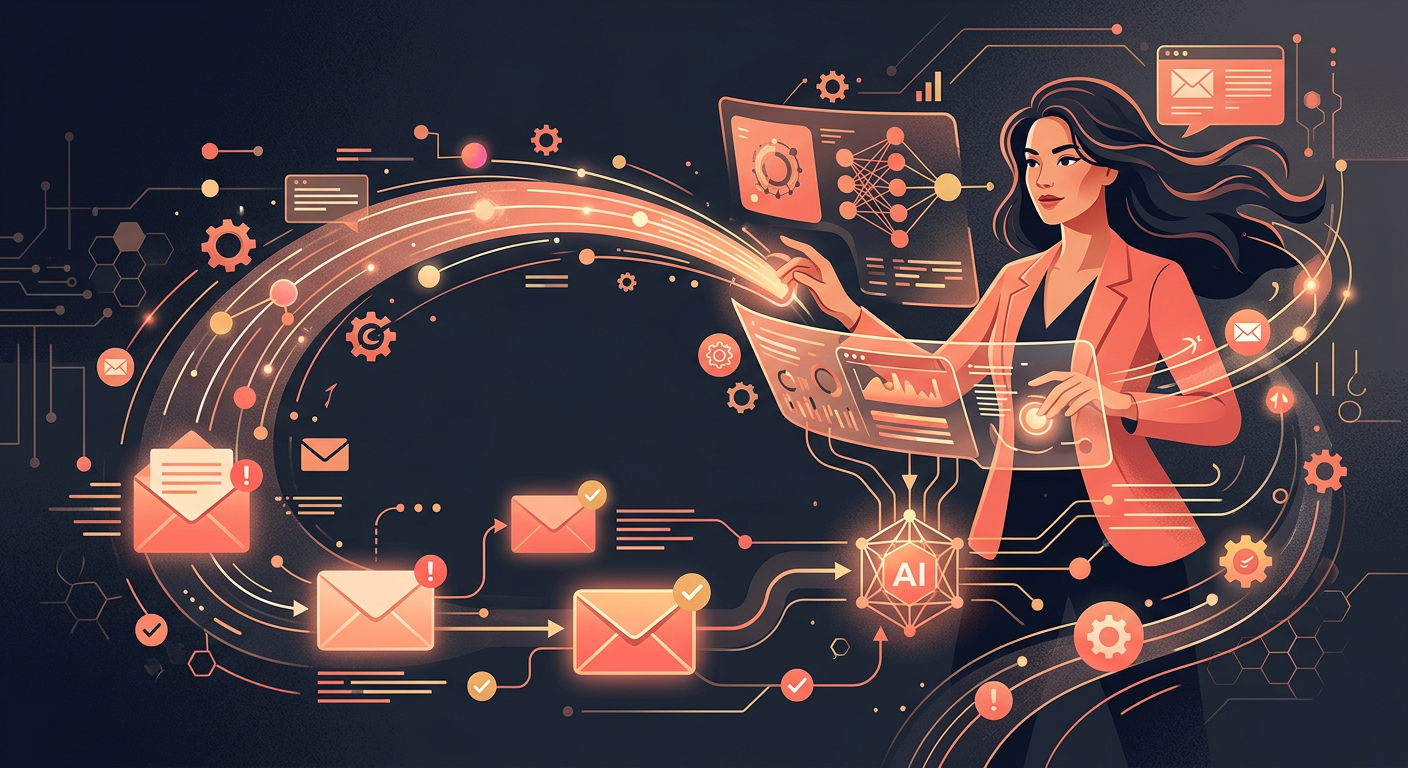
The Art of the Follow-Up in the AI Era
Persistence is often the thin line between a missed opportunity and a successful partnership. However, for many women balancing product building, leadership roles, and creative projects, the manual labor of following up can become a significant bottleneck. This is where the intersection of artificial intelligence and workflow automation changes the game. Learning how to use AI to automate email follow-ups is not just about sending more mail - it is about scaling your influence while maintaining the personal resonance that defines your brand.
At kacibrown.co, we believe that technology should serve your creative vision. By integrating AI into your communication workflows, you move from being a reactive manager of an inbox to a proactive architect of your professional relationships. This shift is a core component of vibe coding for women, where the focus is on using high-level intent to drive complex technical outcomes.
Why Traditional Automation Falls Short
Before diving into the mechanics of AI, it is important to understand why standard automation often fails. Traditional email sequences rely on rigid logic. If a recipient does not reply in three days, send Email B. While functional, these systems are often cold and lack the situational awareness needed for high-stakes networking or sales.
AI changes this by adding a layer of cognitive processing to the automation. Instead of just following a schedule, an AI-enhanced system can analyze the sentiment of a previous interaction, summarize a long thread to provide context for the next nudge, or even determine the optimal time to send a message based on the recipient's historical patterns. This is the difference between a bot and a digital assistant.
Step 1: Setting the Foundation with Vibe Coding
When you start building these systems, you are essentially engaging in a form of software development that prioritizes intent over syntax. This is exactly what we explore in our women-led vibe coding community.
To automate your follow-ups, you first need to define the "vibe" of your communication.
- Voice Consistency: Does your AI understand your unique tone? Use a glossary of your brand terms to train your LLM (Large Language Model) so the output sounds like you, not a generic corporate template.
- Data Centralization: Your AI needs fuel. Whether you use a CRM or a simple spreadsheet, ensure your contact data is structured so the AI can pull names, recent topics of discussion, and specific pain points.
- Goal Clarity: Are you following up on a sales lead, a podcast invitation, or a networking request? Each requires a different automated logic.
Step 2: Choosing Your AI Building Stack
To build a truly intelligent follow-up system, you will likely need a combination of tools that can talk to each other. The goal is to create a seamless loop where information flows from your inbox to an AI model and back to your outgoing mail server.
The Intelligence Layer
Most creators use OpenAI's GPT-4 or Anthropic's Claude as the brain of the operation. These models are excellent at taking a prompt like "Review this last email from Sarah and draft a gentle follow-up that references her recent LinkedIn post about AI ethics" and producing a high-quality draft.
The Automation Layer
Tools like Zapier or Make (formerly Integromat) act as the central nervous system. They connect your email provider (Gmail or Outlook) to your AI model. For example, you can create a "Zap" that triggers when a specific label is applied to an email in your inbox.
The Delivery Layer
While you can have the AI send the email directly, many professionals prefer a "Human-in-the-Loop" system. In this setup, the AI generates the draft and saves it in your "Drafts" folder or sends it to a Slack channel for your final approval. This ensures that you maintain full control over the final output, which is a key principle in our workshops.
Step 3: Crafting the Prompt Engineering Logic
The secret to successful AI automation lies in the prompt. A generic prompt yields a generic email. A sophisticated prompt yields a meaningful connection. Consider a structure that includes:
- Role: "You are a high-level creative strategist."
- Context: "The recipient is a potential collaborator I met at a tech conference."
- Instruction: "Reference our discussion about decentralization and suggest a 15-minute sync next Thursday."
- Constraints: "Keep the email under 100 words. Avoid overly formal language. Do not use the phrase 'I hope this finds you well.'"
By building these instructions into your automated workflow, every follow-up feels bespoke despite being generated in seconds.
Step 4: Implementing Sentiment Analysis
One of the most powerful ways to use AI for follow-ups is sentiment analysis. Imagine a scenario where you receive a reply that says, "I am very busy right now, check back in a month." A standard automation might accidentally send a follow-up two days later, which would be perceived as annoying or disrespectful.
By routing incoming replies through an AI classifier, your system can detect the "not now" sentiment and automatically update your CRM to pause all communications for 30 days. This level of sophistication is what elevates your professional standing and demonstrates that you are utilizing vibe coding for women to build tools that respect human boundaries.
Actionable Steps to Get Started
If you are ready to stop manual following up and start building your AI system, follow these steps:
- Audit your current flow: Identify the three types of emails you send most often. These are your best candidates for automation.
- Start with a Drafts-only workflow: Build a sequence where the AI creates a draft but does not send it. This builds your confidence in the AI's ability to mirror your voice.
- Connect your CRM: Link your automation to your lead tracking system so that every follow-up is logged automatically, saving you even more time on administrative tasks.
- Iterate based on replies: If people are not replying to your AI-generated emails, tweak the prompts. AI building is an iterative process, much like traditional coding, but with a much lower barrier to entry for creative minds.
Why This Matters for Women in Tech
As the first women-led vibe coding community, VibecodHER is dedicated to ensuring that women are not just users of AI, but the architects of it. Automating the mundane tasks of professional life - like the email follow-up - frees up the mental bandwidth required for deep work and innovation. When you master these tools, you are not just saving time; you are claiming your space in the future of technical leadership.
Join the free VibecodHER community to connect with other builders who are leveraging these exact strategies to scale their impact.
Summary of Benefits
- Increased Efficiency: Reach more people in less time without manual typing.
- Personalization at Scale: Use AI to mention specific details that a generic template would miss.
- Consistency: Ensure that no lead or contact falls through the cracks due to a busy schedule.
- Professional Growth: Transition from performing tasks to managing systems.
Frequently Asked Questions
Will my emails get marked as spam if I use AI to automate them?
Not necessarily. Spam filters look for repetitive content and high bounce rates. Because AI allows you to vary the content of each email and personalize the details, AI-generated emails are often less likely to be flagged as spam than traditional, identical templates. However, it is crucial to use a reputable email service provider and maintain a healthy sending volume.
Do I need to know how to code to set this up?
No, that is the beauty of the current era of tech. By using "no-code" tools like Zapier and combining them with AI models, you are engaging in vibe coding. You are describing the logic and the desired outcome in plain English, and the tools handle the technical execution. This accessibility is a core focus of the vibe coding for women movement.
How do I make sure the AI doesn't say something weird?
The best way to ensure quality is to implement a "Human-in-the-Loop" system. Instead of the AI sending the email automatically, have it save the message as a draft. You can then do a quick five-second review before hitting send. Over time, as you refine your prompts and the AI learns your style, you may feel comfortable moving toward full automation for certain types of low-stakes communication. Mastering these workflows is the first step toward becoming a proficient AI builder. By reclaiming your time from the inbox, you open the door to bigger projects and more meaningful innovations. Join the free VibecodHER community