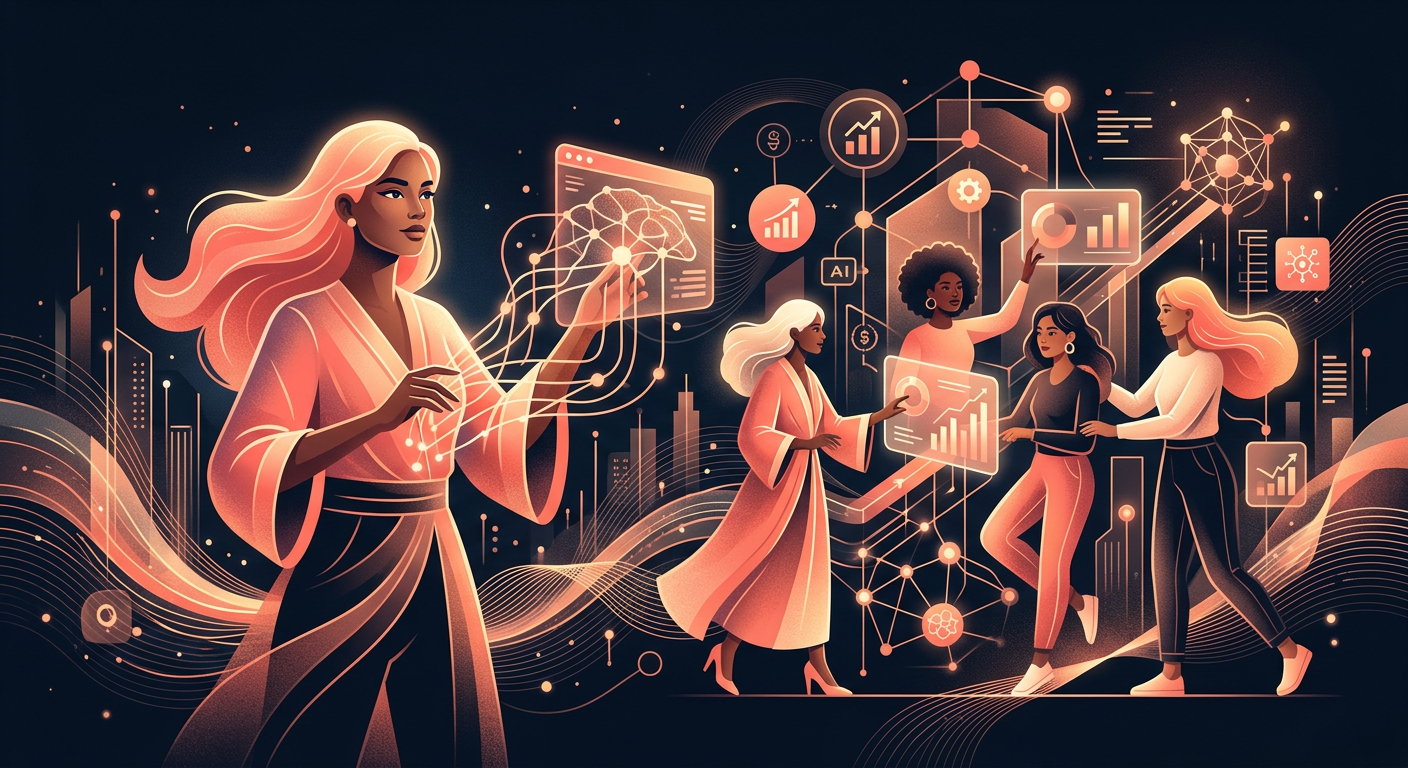
The New Era of Female-Led Artificial Intelligence
The landscape of technology is undergoing a radical shift. For decades, the narrative of Silicon Valley was one dominated by a single demographic, but as we move into 2026, the script has been flipped. We are witnessing the rise of the vibecodher - women who are not just participating in the AI revolution but are architecting its very foundation. These founders are moving beyond the traditional barriers of entry, using intuitive tools and deep domain expertise to build platforms that solve real-world problems.
Women-founded AI startups are increasingly focusing on the intersection of human empathy and machine efficiency. In 2026, the trend is clear: the most successful AI applications are those that treat technology as a collaborator rather than a replacement. Whether it is through decentralized AI, ethical data sourcing, or generative design, female founders are at the forefront of this transformation. This article explores the sectors and startups that are defining this pivotal year in technology.
Why Women-Founded AI Startups are Scaling Fast
The rapid growth of female-led startups in the AI space is not a coincidence. It is the result of several converging factors. First, the democratization of software development through vibe coding and low-code platforms has lowered the cost of building a Minimum Viable Product (MVP). Founders no longer need a massive engineering team to validate an idea. They can use AI to build AI, a concept we explore deeply in our workshops.
Second, there is a growing demand for ethical AI. Recent years have shown that biased algorithms can have devastating real-world consequences. Women founders are statistically more likely to prioritize safety, transparency, and inclusivity in their product roadmaps. This ethical differentiation is becoming a massive competitive advantage in 1 2026 market that values brand integrity as much as technical performance.
Key Sectors for Innovation in 2026
1. Ethical Governance and Algorithmic Auditing
As global regulations around artificial intelligence become more stringent, companies are searching for ways to ensure their models comply with legal standards. This has created a massive opportunity for startups that specialize in AI auditing. Imagine a platform that automatically scans model weights for bias before a single user touches the product. Women founders are leading this charge, building tools that make "trust" a measurable metric.
2. Hyper-Personalized Health and Wellness
In 2026, the generic health app is a thing of the past. New startups are using generative AI to create personalized wellness protocols based on real-time data from wearables and genetic markers. These founders are often drawing from personal experiences in healthcare to build solutions that feel more like a digital companion than a cold database. To understand the terminology behind these innovations, check out our glossary of AI terms.
3. Sustainable Fashion and Circular Economy AI
The fashion industry is one of the world's largest polluters. Female entrepreneurs are leveraging computer vision and predictive modeling to solve the overproduction problem. By predicting trends more accurately and enabling virtual try-on experiences that reduce return rates, these startups are proving that AI can be a force for environmental good.
Spotlighting the Startups to Watch
While the names of specific companies change as they exit stealth or merge, several archetypes of women-founded AI startups are dominating the 2026 headlines. These represent the vanguard of the industry.
The Generative Design Innovators
One of the most exciting areas involves startups that utilize AI to assist in physical product design. Rather than just generating text or images, these platforms allow creators to input functional requirements - such as "aerodynamic, 20% lighter, and biodegradable" - and the AI generates hundreds of blueprint options. This allows smaller, women-owned brands to compete with massive manufacturing conglomerates by optimizing their supply chains through intelligent design.
The Emotional Intelligence (EQ) Layer
As we interact more with digital assistants, the need for emotional nuance has become apparent. A prominent trend among female founders is the development of an "EQ Layer" for LLMs. These startups build specialized wrappers and fine-tuned models that can detect subtle shifts in user sentiment. This is particularly transformative for the mental health space, where AI can now act as an early-intervention tool for burnout or anxiety.
Decentralized Data Marketplaces
Data is the fuel for AI, but for too long, that data has been harvested without consent. A new wave of women-founded startups is using blockchain-integrated AI to create decentralized data marketplaces. In these ecosystems, individuals own their data and lease it to AI developers for training purposes. This flips the traditional power dynamic of the internet and ensures that the wealth generated by AI is more equitably distributed.
Actionable Steps for Aspiring AI Founders
If you are inspired by these founders and want to start your own AI journey, 2026 is the perfect time to begin. The tools are more accessible than ever, and the community support is vast. Here is how you can get started:
- Master the Vibe: Understand that you do not need to be a computer science PhD to build in AI. Focus on the "vibe" or the high-level logic of your application, and use AI agents to handle the syntax.
- Identify a Niche Problem: The most successful startups in 2026 are not "general AI" companies. They are specific solutions for a single industry, like AI for boutique law firms or AI for sustainable urban farming.
- Join a Peer Network: Building in isolation is the fastest way to burn out. Find a group of like-minded women who are also building. This is exactly why we built our community space.
- Prioritize Ethics from Day One: Do not wait until your product is large to think about bias. Build transparency and data privacy into your core architecture.
The Role of Vibe Coding in Scaling Female Tech
Vibe coding is a term we use to describe the intuitive process of building software by communicating intent rather than just writing code. For women who have historically been excluded from traditional developer circles, vibe coding is a superpower. It allows a founder to stay in the creative flow while the heavy lifting of code generation is handled by LLMs. In 2026, the divide between the "idea person" and the "tech person" has collapsed. Every founder is now a tech founder.
This shift is particularly evident in the current crop of successful AI startups. Many of the women leading these companies do not come from a traditional CS background. Instead, they come from marketing, healthcare, biology, or the arts. They bring a fresh perspective to technology that is focused on the user experience rather than just technical specs. By staying close to the vibe, they are building more humane, useful products.
Challenges and Opportunities for 2026
Despite the progress, female founders still face unique challenges. Funding gaps persist, although they are narrowing as venture capitalists realize that female-led teams often provide higher returns on investment. The opportunity lies in the fact that the most valuable AI companies of the next decade are likely being built right now in living rooms and small studios by women who are unencumbered by the old ways of doing things.
We are moving toward a future where the AI ecosystem is as diverse as the population it serves. This diversity is not just a social goal - it is a technical necessity. A more diverse group of builders leads to more robust, creative, and safe technology.
FAQ: Women in AI Startups
How can I find funding for my AI startup in 2026?
Funding is increasingly found in niche AI grants and female-focused VC funds. Additionally, many founders are choosing to bootstrap their initial builds using low-cost AI development tools before seeking outside capital. Networking within a dedicated community of other builders is often the best way to get warm introductions to investors who understand the AI landscape.
Do I need a technical co-founder to start an AI company?
While having a technical partner is helpful, it is no longer strictly necessary in 2026. With the advancement of vibe coding and AI-assisted development, non-technical founders can build complex, functional prototypes and even full-scale applications. The focus has shifted from "Can you code?" to "Can you curate and direct the AI to code for you?"
What are the most important AI trends for 2026?
Key trends include the rise of edge AI (AI running locally on devices), the integration of emotional intelligence into LLMs, and a heavy focus on data sovereignty. There is also a significant movement toward smaller, more efficient models that do not require the massive energy output of the early GPT era.
How do I stay updated on women in tech news?
You can stay informed by following industry-specific newsletters, attending workshops, and participating in professional networks. Engaging with specialized platforms that highlight female achievements in tech helps you keep a pulse on which startups are gaining traction and which technologies are worth learning.
Closing Thoughts
The trajectory for 2026 is clear: women are no longer just the users of AI; they are the architects. By focusing on ethics, human-centric design, and niche problem-solving, women-founded AI startups are setting a new standard for what a tech company should look like. Whether you are an investor looking for the next big thing or a budding entrepreneur ready to build your first app, the opportunities are endless.
If you are ready to start building your own AI vision and want to connect with other innovators who are changing the game, we invite you to take the next step. Collaboration is the key to scaling in this fast-paced environment.
Join the free VibecodHER community
Where Women in Vibe Coding Build Together
Vibe coding for women is more than a category - it's a movement. VibecodHER is the first women-led vibe coding community in the world, founded to give women a space to learn, ship, and lead. Join the free community on Skool.