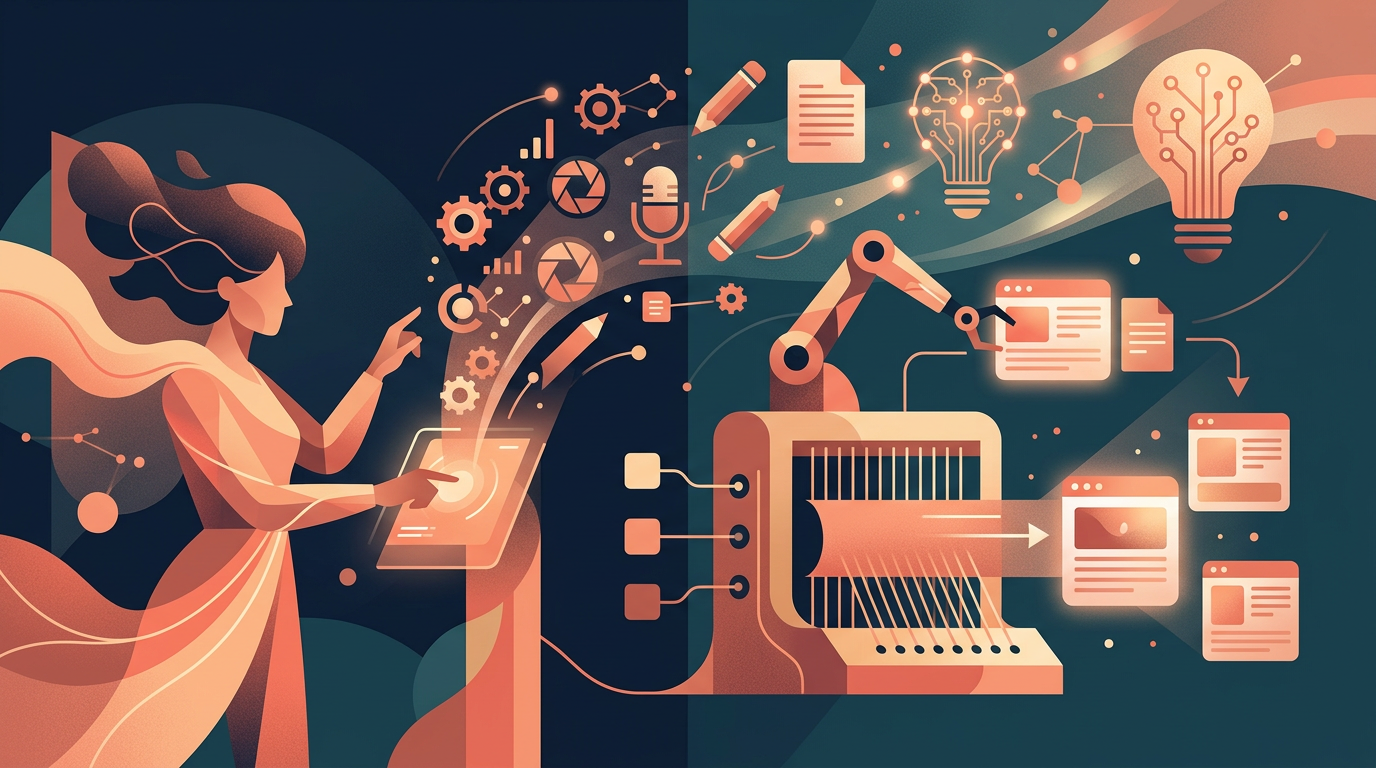
Why Content Automation is the New Standard for Creators
The traditional way of creating content is broken. Sitting in front of a blinking cursor, waiting for inspiration to strike, and manually resizing images for three different social platforms is a recipe for burnout. If you are trying to build a personal brand or grow a business, you need a workflow that works as hard as you do. This is where the magic happens: learning how to automate content creation using AI tools.
But this isn't about churning out generic, robotic filler. At kacibrown.co, we lean into vibe coding-the art of using high-level intent and AI logic to manifest digital assets that feel human, authentic, and aligned with your unique voice. Automation is simply the engine that allows your creativity to travel further. By leveraging Large Language Models (LLMs), image generators, and automation platforms, you can transform one core idea into a month’s worth of multi-channel content in less than an hour.
The Philosophy of Vibe-Driven Automation
Before we dive into the technical stack, we must address the mindset. Automation without a soul is just noise. When you use tools like ChatGPT, Claude, or Midjourney, you aren't just "outsourcing" work; you are collaborating with a digital partner.
Successful automation requires a solid foundation in terms. If some of these concepts are new to you, I highly recommend browsing our glossary to get up to speed on terms like 'Tokenization,' 'Prompt Chaining,' and 'Zero-Shot Learning.'
Step 1: Mapping Your Content Pillars
To automate content creation using AI tools effectively, you must first define what you stand for. AI needs constraints to be creative. Start by identifying three core pillars. For example:
- Educational (Tutorials and How-Tos)
- Inspirational (Personal Journey and Vibe Coding)
- Community-Centric (Q&A and Community Highlights)
Building Your AI Content Stack
To build an automated engine, you need a balanced ecosystem of tools. You don't need a dozen subscriptions-usually, 3 to 4 well-chosen platforms will do the heavy lifting.
The Brain: LLMs for Text and Strategy
ChatGPT (GPT-4o) or Claude 3.5 Sonnet serve as the central nervous system. These tools handle brainstorming, outlining, and drafting. They are also excellent at repurposing long-form content into short-form snippets.
The Eyes: AI Image Generation
Tools like Midjourney or DALL-E 3 allow you to create custom visuals that match your aesthetic. Instead of using tired stock photos, you can generate images that reflect your specific brand "vibe."
The Glue: Automation Platforms
Zapier or Make.com allow your tools to talk to each other. For example, when you save a new idea in Notion, Zapier can trigger a prompt in ChatGPT to generate a social media caption and then save it to a Google Sheet for your review.
Tutorial: The "One-to-Many" Automation Workflow
This is a practical framework you can implement today to multiply your output without increasing your screen time.
Phase 1: The Seed Content
Start with one high-quality piece of long-form content. This could be a recorded video, a podcast episode, or a detailed blog post like this one.
Actionable Step: Record a 10-minute voice memo on a topic you're passionate about. Use a tool like Otter.ai or Descript to transcribe it. This transcript is your "source of truth."
Phase 2: The Multi-Channel Extraction
Take that transcript and feed it into an LLM with a specific prompt.
Prompt Example: "I am providing a transcript of a talk I gave. Please extract five key insights and write them as high-energy LinkedIn posts. Then, create three Twitter (X) threads that summarize the process. Maintain a tone that is encouraging, expert, and focused on vibe coding."
Phase 3: Visual Generation
For each social post, you need a visual. Instead of searching, use your AI image generator.
Actionable Step: Create a consistent "style prompt" for your brand. Example: "Minimalist 3D render, futuristic workspace, pastel purple and chrome accents, high resolution, soft lighting." Use this prompt for every image to ensure your feed looks cohesive.
Phase 4: Hands-Free Scheduling
Once your text and images are generated, use a scheduler like Buffer or Later. If you want to go full-pro, use a Python script (a classic vibe coding move) to upload your content folder directly to your social calendar via API.
Mastering the Human-in-the-Loop Factor
One mistake many creators make when trying to automate content creation using AI tools is removing themselves from the process entirely. This is a mistake. AI is the co-pilot, not the pilot.
The 80/20 Rule of AI Content
- 80% Automation: Drafting, resizing, formatting, and scheduling.
- 20% Human Intervention: Fact-checking, personal anecdotes, final tone tweaks, and responding to comments.
By keeping your foot in the door, you ensure that the content remains grounded in reality and continues to build trust with your community.
Advanced Vibe Coding Techniques for Creators
If you want to move beyond basic prompts, consider attending one of our workshops. We dive deep into custom GPTs and local LLMs that can be trained specifically on your past writing.
Custom GPTs for Brand Consistency
You can build a "Style Bot" within ChatGPT. Upload your previous newsletters, blog posts, and tweets to the Knowledge base. Instruction: "You are my brand voice assistant. Every time I give you a rough idea, rewrite it in my voice, ensuring you use my favorite metaphors and avoid corporate jargon."
Automating Video Content
Tools like HeyGen or Canva’s AI video suite allow you to create short-form video clips or even use an AI avatar to deliver your insights. This is perfect for those days when you aren't "camera-ready" but still want to maintain a daily posting cadence.
Avoiding the Pitfalls of Content Automation
While the goal is efficiency, there are traps to avoid:
- The 'AI Echo Chamber': If you only use AI to research, you'll end up saying the same thing as everyone else. Use your original ideas as the input.
- Ignoring SEO: AI-generated text can sometimes be repetitive. Use SEO best practices (like those we teach in our vibecodher program) to ensure your content actually ranks on Google.
- Over-Automation: Don't automate your direct messages or community interactions. Real connection cannot be coded.
Your Action Plan for This Week
- Select your stack: Pick one LLM and one automation tool (Make or Zapier).
- Create a 'Brand Bible' PDF: Document your tone, colors, and mission. You will feed this to your AI tools.
- Run a 'One-to-Many' test: Turn one old blog post into 5 social media snippets using the tutorial steps above.
- Join the conversation: Share your results in our community and see how others are ethicaly scaling their reach.
Conclusion
Learning to automate content creation using AI tools is the ultimate leverage for the modern woman in tech. It frees your mind from the mundane and allows you to focus on high-level strategy and genuine connection. Remember, we don't just build; we vibe code. We create systems that reflect our energy and amplify our impact.
Are you ready to stop struggling with your content calendar and start building a digital empire? Join us at VibecodHER to master the tools of the future.
How do I ensure AI content doesn't sound robotic?
The key is providing 'Voice Samples.' Instead of a generic prompt, provide the AI with 3-5 examples of your best writing. Use the instruction: "Analyze the tone, sentence structure, and vocabulary of these samples, and mimic them in all future outputs."
Will using AI for content hurt my SEO rankings?
Google's primary focus is on helpful, high-quality content. As long as your automated content provides genuine value, is factually accurate, and includes your unique perspective, it can rank very well. Always do a final human pass to add 'EEAT' (Experience, Expertise, Authoritativeness, and Trustworthiness).
What is the best AI tool for beginners starting content automation?
I recommend starting with Claude 3.5 Sonnet for writing-it tends to have a more 'human' and melodic tone than other models. Pair it with Canva’s 'Magic Switch' feature to quickly turn one design into multiple formats for different social platforms.
Can I automate my entire social media presence?
While you can automate the posting and drafting, you should never automate the 'social' part of social media. Engaging with your followers, answering questions in the community, and building relationships should always stay human-led.
Where Women in Vibe Coding Build Together
Vibe coding for women is more than a category - it's a movement. VibecodHER is the first women-led vibe coding community in the world, founded to give women a space to learn, ship, and lead. Join the free community on Skool.