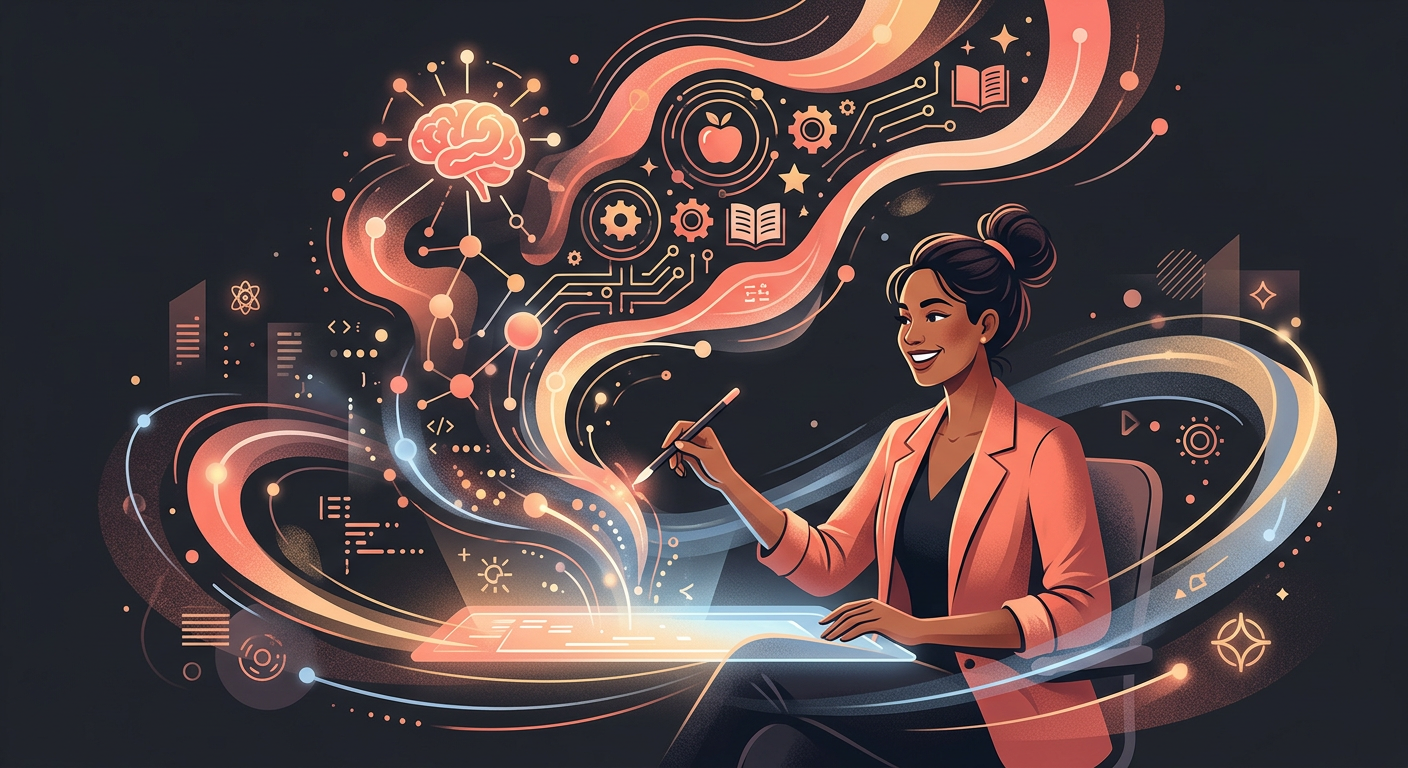
The New Frontier: Why Vibe Coding for Education Professionals Matters
The traditional classroom is undergoes a radical transformation. For decades, the barrier between a teacher's creative vision and the technology available to implement it has been high. Educators have often felt like passive consumers of software designed by people who have never stood in front of a classroom. However, the emergence of vibe coding for education professionals is changing that dynamic entirely.
Vibe coding represents a shift from writing rigid syntax to directing high-level intent. It is an approach where you describe what you want a piece of software to do, feel like, and achieve, and use artificial intelligence to generate the underlying logic. For teachers, this means the ability to build custom grading assistants, interactive lesson planners, and personalized student portals without needing a degree in computer science.
At its core, vibe coding for women in education is about reclaiming agency. It ensures that the tools used to teach the next generation are built by the people who understand the students best. By leveraging natural language, educators can now iterate on ideas in real-time, bridging the gap between instructional design and technical execution.
Understanding the Vibe Coding Movement
To grasp why this is so revolutionary, one must look at the glossary of modern AI development. Traditional coding requires learning specific languages like Python or JavaScript. While these are powerful, the learning curve is often too steep for a full-time professional in the education sector.
Vibe coding, on the other hand, focuses on the "vibe" - the objective, the tone, and the user experience. You are no longer just a coder; you are an architect of intent. This movement is gaining significant traction within our /vibecodher initiative, which focuses on making these high-tech capabilities accessible to everyone, regardless of their prior technical background.
As the first women-led vibe coding community, VibecodHER provides a space where educators can move beyond the frustration of one-size-fits-all software. Instead of waiting for a tech company to release a feature you need, you can simply "vibe" it into existence. This is particularly important for marginalized voices in tech, as it lowers the barrier to entry for innovation.
Practical Applications in the Classroom
Imagine a world where your administrative burden is halved. Vibe coding for education professionals offers several practical applications that can be implemented almost immediately.
Custom Lesson Plan Generators
Every classroom has unique needs. A standard lesson plan generator might not account for specific neurodivergent requirements or local community context. By using vibe coding techniques, an educator can build a tool that takes a curriculum standard and automatically refines it into three different versions based on student reading levels. You describe the tone (encouraging, academic, or playful), and the AI builds the structure.
Interactive Student Feedback Loops
Feedback is the most critical part of learning, but it is also the most time-consuming. You can create a vibe-coded interface where you input a student's essay and your shorthand notes, and the system generates a warm, constructive, and detailed response that follows your specific pedagogical philosophy. This ensures consistency without sacrificing the human touch.
Virtual Teaching Assistants
You can build a specialized chatbot for your class that doesn't just answer general questions, but answers questions based specifically on your syllabus and lecture notes. This allows students to get help at 9:00 PM when you are off the clock, using a tool that reflects your unique teaching voice.
How to Start Your Vibe Coding Journey
Transitioning from an educator to an AI builder might seem daunting, but the process is more intuitive than you think. Here are the steps to begin.
- Identify the Friction: Look at your workday. What is the one task that feels repetitive or draining? This is your first project.
- Define the Intent: Before touching any AI tool, write down exactly what success looks like. If this tool worked perfectly, what would the output be? How would it make the student feel?
- Use Natural Language: Start communicating with AI models like Claude or GPT-4. Describe the tool you want to build. Use phrases like "I want a web app that helps students track their reading progress with a calming, aesthetic interface."
- Refine and Iterate: This is where the "vibe" comes in. If the AI produces something too clinical, tell it to make it warmer. If it is too complex, tell it to simplify the UI. You are the creative director of your own software.
- Join a Community: Learning in isolation is difficult. Engaging with a women-led vibe coding community allows you to share prompts, troubleshoot errors, and celebrate wins with others who understand your professional context.
Breaking the Barrier: Vibe Coding for Women in Tech and Education
For too long, the tech industry has been a gatekept environment. Vibe coding for women represents a massive opportunity to shift the power balance. In education, where women make up the majority of the workforce, having the skills to build custom AI tools is a form of professional empowerment.
When we talk about vibe coding for women, we are talking about creating technology that prioritizes empathy, collaboration, and social impact. Education is the perfect proving ground for these values. By learning to vibe code, teachers can ensure that classroom AI is ethical, inclusive, and truly helpful.
You can explore more about these specific skill sets by attending our workshops, where we break down the process of building your first AI agent specifically for an educational setting.
Case Study: The Narrative Builder
Imagine a history teacher who wants to make the industrial revolution more engaging. In the past, she might have searched for an educational game online, only to find something outdated or expensive.
Through vibe coding, she describes a "choose your own adventure" style interface. She tells the AI: "Build a text-based game where the student is a factory worker in 1840. The tone should be gritty but educational. Every choice should lead to a historical fact." Within minutes, she has a functioning prototype. She didn't write a line of code; she communicated a vision and refined the "vibe" until it matched her educational goals. This is the power of becoming an AI-enabled educator.
The Role of Community in Your Growth
As you begin to experiment, you will likely encounter moments of uncertainty. This is why joining our community is so vital. There is a specific kind of magic that happens when educators and builders come together to solve problems.
In the first women-led vibe coding community, we focus on the intersection of creativity and logic. We provide the resources you need to move from "I have an idea" to "I built this tool for my students." Whether you are looking for specific prompt templates or just want to see what other teachers are creating, finding your tribe is the fastest way to accelerate your learning.
The Future of Education is Vibe-Coded
We are moving away from the era of software being something that is "done to us" and into an era where software is something we influence and create. For education professionals, this is a chance to lead. By adopting vibe coding early, you position yourself as a forward-thinking leader in your school or district.
This isn't just about saving time - it's about improving student outcomes. When a teacher can build a bespoke tool for a student who is struggling with a specific concept, that student receives a level of personalized attention that was previously impossible. Vibe coding makes the impossible, possible.
Actionable Takeaways for Educators
- Start Small: Don't try to build a full Learning Management System on day one. Build a simple email responder or a quiz generator.
- Focus on the UI: Since vibe coding is heavily reliant on visual output and user experience, focus on how the tool feels to use. This is often more important for students than the underlying complexity.
- Document Your Process: Keep a log of the prompts that worked. This helps you build a library of "vibes" that you can reuse for future projects.
- Teach Your Students: Once you are comfortable, show your students how you built the tool. This demystifies AI for them and encourages them to become creators as well.
Frequently Asked Questions
Do I need to know any programming languages to start vibe coding?
No. The beauty of vibe coding is that it relies on natural language. If you can describe a concept clearly in English, you can vibe code. While understanding basic logic helps, the AI handles the syntax, allowing you to focus on the instructional design and the user experience.
Is vibe coding secure for use with student data?
Security is a critical consideration. When building tools, you should never input sensitive student PII (Personally Identifiable Information) into public AI models. Vibe coding for education professionals emphasizes building the structure of the tool. For data processing, you should use secure, enterprise-grade versions of AI tools that comply with local privacy laws like FERPA or GDPR.
How is vibe coding different from just using ChatGPT?
Using ChatGPT is often a one-off interaction. Vibe coding involves using AI to create a persistent tool or application. It's the difference between asking a question and building a custom calculator that you can use every day. Vibe coding results in a functional piece of software that can be shared and reused.
Can I use vibe-coded tools on my school's existing platforms?
In many cases, yes. Many vibe-coded tools can be exported as web apps or integrated into platforms like Notion, Canvas, or Google Workspace via APIs. As you progress in your journey with the VibecodHER community, you will learn how to bridge the gap between your custom builds and the tools your school already uses.
Join the Movement
Building the future of education requires a new set of skills. It requires the courage to experiment and the support of a community that believes in your potential. You don't have to navigate the world of AI alone.
Ready to start your journey? Join the free VibecodHER community and connect with other women who are using vibe coding to change the world of education. We provide the tutorials, the encouragement, and the network you need to transition from a tech user to a tech creator. See you on the inside!