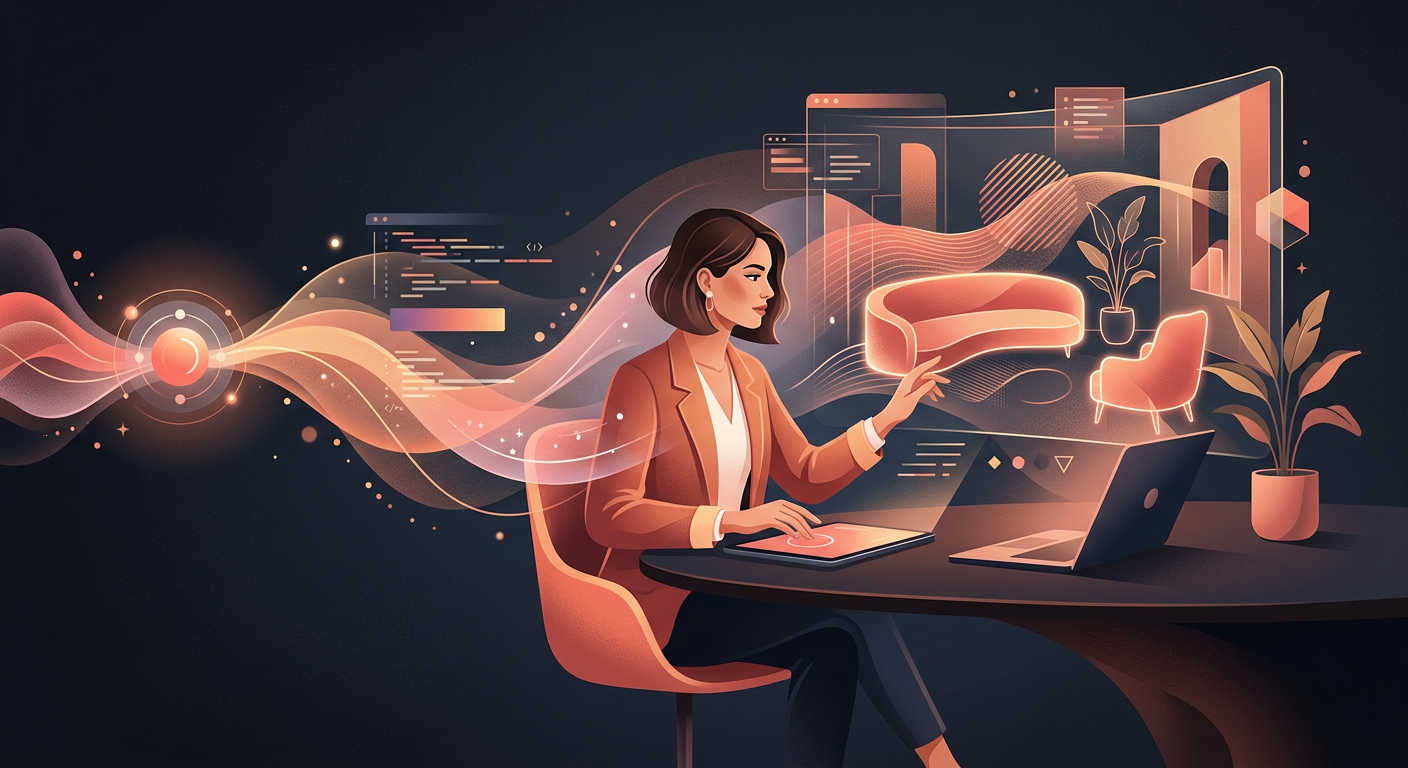
Redefining Spatial Creativity Through Vibe Coding
The intersection of technology and aesthetic expression has reached a pivotal turning point. For years, interior designers have relied on complex CAD software, manual mood boards, and physical samples to communicate a vision. But a new era has arrived: the era of vibe coding. This approach to creation allows designers to move from stagnant drawings to living, breathing digital ecosystems without needing to master traditional programming languages.
At its core, vibe coding for interior design professionals is about using natural language and intent to build custom tools, applications, and visualizations. It is the ultimate bridge between the artistic 'vibe' of a room and the technical execution required to make it a reality. By leveraging generative AI and large language models, designers can now program through conversation, creating bespoke client portals or AI-driven layout generators that reflect their unique style.
Understanding the Vibe Coding Movement
To grasp why this matters, we must first define the concept within our specific ecosystem. Vibe coding is the act of building functional software or technical assets by describing the desired outcome and 'feel' rather than writing line-by-line code. For the interior design professional, this means you are no longer limited by the features available in off-the-shelf software.
You can learn more about the basic terminology in our glossary. When you engage in vibe coding for women in the design space, you are taking back control of your technical stack. You are shifting from a passive user of software to an active architect of your own digital tools.
Imagine a world where your creative intuition directs an AI to build a custom inventory management system that automatically categorizes furniture by 'mood,' 'texture,' and 'lighting shadow profile.' This is not a distant future; it is the current reality for those in our community.
Why Interior Design is the Perfect Use Case for Vibe Coding
Interior design is inherently about the 'vibe.' It is about the emotional resonance of a space, the way light hits a velvet sofa, and the flow of a floor plan. Traditional software often feels cold and clinical, forcing creative minds into rigid boxes. Vibe coding flips the script.
1. Custom Visualization Tools
Instead of waiting for a developer to build a specific rendering plugin, you can vibe code a custom script that adjusts the color temperature of your digital models based on real-world golden hour data. You describe the atmosphere you want to achieve, and the AI translates that into functional logic.
2. Client Experience Automation
The client journey in high-end interior design is deeply personal. Through women-led vibe coding community initiatives like VibecodHER, designers are learning to build custom 'vibe-check' apps. These apps allow clients to upload photos of objects they love, while the AI underlying the app identifies the common aesthetic thread and suggests a design direction that matches the designer's signature style.
3. Sustainable Sourcing AI
Sourcing is one of the most time-consuming aspects of the job. By vibe coding a custom search agent, you can create a tool that combs through thousands of vendor catalogs specifically for 'mid-century modern pieces with sustainable certifications under a specific price point.' You aren't just searching; you are building an intelligent scout that understands your taste.
Practical Steps to Start Vibe Coding Today
Transitioning into this space does not require a computer science degree. It requires a shift in mindset. Here is how you can begin integrating these techniques into your interior design practice.
Step 1: Identify Your Friction Points
Look at your current workflow. Where do you feel slowed down by manual tasks? Is it the creation of lighting schedules? Is it organizing fabric swatches? These friction points are the perfect candidates for your first vibe coding project. If you are unsure where to start, our workshops provide hands-on guidance for identifying these opportunities.
Step 2: Use Natural Language as Your Code
Start using AI chat interfaces to describe the tools you wish you had. For example, you might say: 'I want to create a web-based dashboard where I can drag and drop images, and the system automatically generates a hex code color palette based on the dominant tones and suggests three textures that would complement them.' The AI will then provide the structure and code necessary to make this dashboard a reality.
Step 3: Iterate and Refine
The beauty of vibe coding is that it is conversational. If the first version of your tool doesn't quite capture the 'vibe' you intended, you simply explain why. You might tell the AI, 'The layout feels too corporate; make the edges softer and the typography more elegant.' The system adjusts in real-time.
Building Your Professional Identity with VibecodHER
As the industry evolves, the most successful designers will be those who can blend high-touch human creativity with high-tech execution. This is where VibecodHER comes in. As the first women-led vibe coding community, we focus specifically on the nuances of how women in creative fields interact with technology.
We believe that tech should be an extension of your creative hand, not a barrier to it. In our community, interior designers are finding peers who are building more than just websites - they are building AI-powered design assistants that understand the difference between 'minimalist' and 'stark,' or 'maximalist' and 'cluttered.'
Case Study: From Mood Boards to AI Dashboards
Consider a scenario where an interior designer focuses on wellness-based residential spaces. Traditionally, she would spend hours researching biophilic design principles and manually checking them against her floor plans.
By embracing vibe coding, she can build a custom 'Wellness Auditor.' She uploads her floor plan and describes the vibe: 'I want this space to maximize natural light and promote a lowered cortisol level.' The AI, programmed through her specific 'vibe' instructions, highlights areas where the furniture blocks light or where the flow is too chaotic. She has effectively duplicated her expertise into a digital tool that works alongside her.
Overcoming the 'Tech' Hurdle
Many interior design professionals feel alienated by the language of Silicon Valley. Terms like 'API integration' or 'backend infrastructure' can feel intimidating. However, vibe coding is the antidote to this technical gatekeeping. It centers the human voice.
In the context of vibe coding for women, the focus is on utility and expression. It is about making the machine speak our language, rather than us being forced to speak its language. This shift empowers you to be the CEO and the Lead Architect of your digital presence without having to spend years learning Python or JavaScript.
Actionable Takeaways for Interior Designers
- Start Small: Don't try to automate your entire business on day one. Start by vibe coding a simple tool, like a custom email responder that captures the aesthetic of your brand.
- Focus on the Vibe: Your strength is your eye for design. Use that. When prompting AI to build tools, use the same descriptive language you use with your clients.
- Join a Support System: Tech is less daunting when you aren't doing it alone. Engaging with a women-led vibe coding community ensures you have the resources and encouragement to keep pushing boundaries.
- Check out VibecodHER: This is your home for learning how these technologies apply specifically to your career as a creative professional.
The Future of the Industry
The interior designers of the future won't just be choosing paint colors; they will be curated experiences across both physical and digital realms. Vibe coding allows you to build the bridges between these worlds. Whether it's an Augmented Reality (AR) app that lets clients see your 'vibe' in their actual living room or a backend system that handles the logistics of international shipping for custom furniture, the power is in your hands.
By leveraging these tools, you reclaim time. That time can be reinvested into what you do best: the high-level creative vision that no AI can ever truly replace. The machine handles the logic; you provide the soul.
What is vibe coding exactly for someone who isn't tech-savvy?
Vibe coding is a way of creating software or digital tools by simply describing what you want in plain English. For an interior designer, it’s like telling a very smart assistant, 'Build me a private gallery where my clients can see my furniture picks and leave comments,' and having that assistant build the actual website or app for you instantly. It removes the need to learn complex coding languages.
How can vibe coding help me get more clients?
By using vibe coding to build unique, high-tech experiences - such as a custom AI style quiz on your website or an interactive digital mood board - you differentiate yourself from competitors. It shows clients that you are at the forefront of innovation and can provide a more seamless, modern service that others cannot.
Is vibe coding expensive to implement in my design firm?
Actually, vibe coding is often more cost-effective than traditional software development or paying for multiple expensive subscriptions. Most of the tools used for vibe coding are accessible through affordable AI platforms. The primary investment is your time to learn how to communicate your 'vibe' to the AI, which is exactly what we teach in VibecodHER.
Do I need to be good at math or logic to vibe code?
Not at all. Vibe coding relies on your ability to describe aesthetics, feelings, and workflows. If you can describe a room to a client, you can vibe code. It is more about communication and vision than it is about equations or traditional logic structures.
Building a future where your design business is powered by your own custom-built tools is the ultimate competitive advantage. This journey is about more than just efficiency; it is about creative liberation.