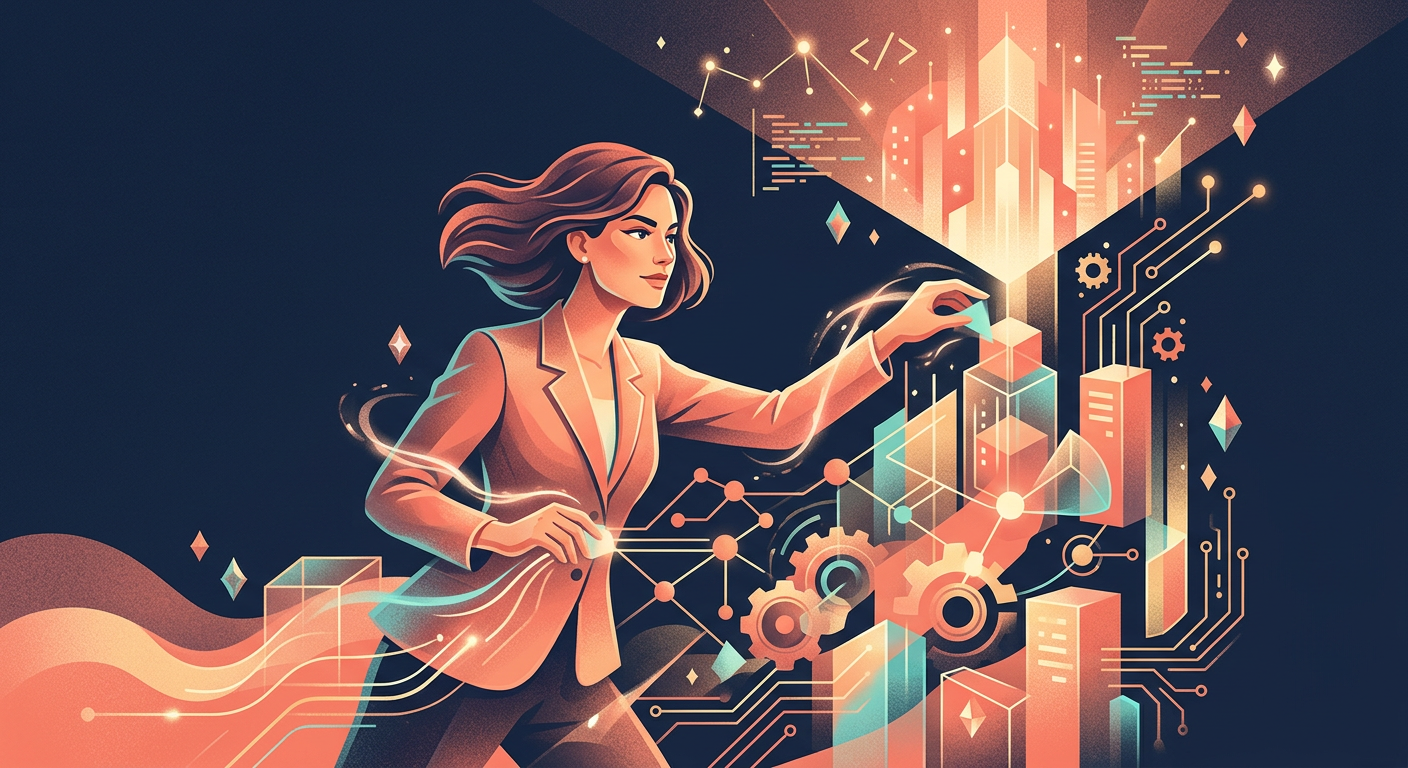
Embracing the Vibe Coding Mindset: A New Paradigm for Creators
The world of software development is undergoing a seismic shift. For decades, the barrier to entry for building digital tools was the mastery of syntax-learning the specific sequence of characters, semi-colons, and brackets required to make a computer perform a task. But today, thanks to the rise of Large Language Models (LLMs) and the evolution of natural language processing, we are entering the era of vibe coding.
At VibecodHER, we define vibe coding not just as a technical shortcut, but as a fundamental shift in perspective. Founded by Kaci Brown, our community is dedicated to empowering women and non-binary creators to harness this power. To succeed in this new landscape, you must adopt a specific vibe coding mindset: prioritizing the vision over the syntax and thinking like a high-level builder rather than a traditional line-by-line coder.
What is the Vibe Coding Mindset?
The vibe coding mindset is the mental framework of focusing on intention, logic, and user experience while delegating the technical implementation to AI. In the past, if you wanted to build an app, you had to spend months learning Python or JavaScript. You were a "coder." Today, you are an architect. You describe the "vibe," the functionality, and the flow, and the AI generates the code.
However, "vibe coding" doesn't mean "lazy coding." It requires a sharp, analytical mind that can communicate complex ideas clearly. It’s about moving from the how to the what and the why.
The Core Pillars of a Vibe Coder
- Vision-First Approach: You see the completed project in your mind before a single line is written.
- Iterative Thinking: You understand that the first prompt is rarely the final product.
- Context Management: You know how to provide the AI with the right background information to get the best result.
- Critical Evaluation: You don't just copy-paste; you verify that the output matches your "vibe."
| Traditional Coding Mindset | Vibe Coding Mindset |
|---|---|
| Focus on syntax and libraries | Focus on logic and user flow |
| Hours spent debugging typos | Minutes spent refining prompts |
| Barrier to entry: Technical degree | Barrier to entry: Creativity and logic |
| Thinking in "If/Else" statements | Thinking in "Features and Feelings" |
| Solitary problem solving | Collaborative AI-partnering |
Moving From Syntax to Systems
One of the hardest hurdles for beginners-and even seasoned developers-is letting go of the need to "know" the code perfectly. To truly adopt the vibe coding mindset, you must start thinking in systems.
When you think like a builder, you aren't worried about whether a variable is camelCase or snake_case. You are worried about how Data Point A moves to Dashboard B to provide Value C to the user. This systemic thinking is what we teach in our workshops, where we help members map out their application logic before they ever touch an LLM.
How to Practice Systemic Thinking
- Mind Mapping: Before writing a prompt, draw your app's flow on paper or a digital whiteboard.
- Pseudo-coding: Write out what you want to happen in plain English (e.g., "When the user clicks the 'Save' button, send the text to the database and show a green checkmark").
- Requirement Analysis: Break your big idea into small, bite-sized components.
The Role of the Builder vs. The Coder
In the traditional sense, a coder is often a specialist. They might be a "React Developer" or a "Backend Engineer." But a builder is a generalist who understands the big picture.
By joining the VibecodHER community, you learn that being a builder gives you more agency. You aren't limited by the languages you know; you are only limited by the ideas you can articulate. Kaci Brown founded this community on the belief that when we remove the "coding" gatekeeper, we unlock a massive wave of innovation from diverse voices who were previously sidelined by the technical steepness of the industry.
Why Builders Win in the AI Era
- Speed: A builder can prototype a functional MVP (Minimum Viable Product) in a weekend.
- Adaptability: If a new AI model comes out, a builder switches their tool; a coder might have to relearn their craft.
- Problem-Solving: Builders focus on solving a human problem, not a technical puzzle.
Mastering the Language of Vibration (Prompting)
The "vibe" in vibe coding refers to the essence of the project. To communicate this vibe, you need to master the art of the prompt. This is the primary tool of the vibe coding mindset.
Think of the AI as a highly skilled intern. If you give vague instructions, you get vague results. If you provide a detailed "vibe," a persona, and clear constraints, you get magic.
Actionable Prompting Tips for Builders
- Set the Persona: Start your prompt with "You are an expert Full-Stack Developer specializing in clean, minimalist SaaS applications."
- Provide Context: Tell the AI who the user is and what the ultimate goal is.
- Define the Aesthetic: Don't just ask for a website; ask for a "modern, dark-themed interface with vibrant neon accents and high-contrast typography."
- Iterate and Refine: If the code isn't right, don't give up. Tell the AI, "The logic is correct, but the layout feels cluttered. Let's add more white space and simplify the navigation."
To see real-world examples of how our members use these techniques, check out our blog for deep dives into specific project builds.
Overcoming the "Imposter Syndrome" of High-Level Building
A common challenge when adopting the vibe coding mindset is the feeling that you are "cheating" because you didn't write every line of code manually. This is a fallacy.
Building is building. Whether you use a hammer and nail or a nail gun, the house still stands. In our community, we celebrate the "vibe." We focus on the fact that you brought an idea to life that didn't exist before. Our founding members are doctors, artists, stay-at-home moms, and career changers who have realized that their life experience is more valuable than their ability to memorize a coding documentation page.
The Practical Steps to Transitioning
If you're ready to shift your perspective and embrace the builder's path, follow these steps:
- Start Small: Don't try to build the next Facebook on day one. Build a simple habit tracker or a personal portfolio.
- Learn the Glossary: While you don't need to code, you should know what terms like "API," "Database," "Frontend," and "Deployment" mean. Our glossary is a great place to start.
- Focus on the UX: Since you aren't spending time on syntax, spend that extra time making the user experience incredible. Use tools like Figma or even just pencil and paper to design the "vibe."
- Learn to Debug the Vibe: When the code breaks (and it will), don't panic. Read the error message, paste it back into the AI, and ask it to explain why it happened. This is how you learn the logic without the headache.
Building with Soul: The VibecodHER Way
At its core, the vibe coding mindset is about putting the "soul" back into software. When we focus less on the technical constraints, we can focus more on the human impact.
Kaci Brown often says that vibe coding is the ultimate democratizer. It allows us to build inclusive, accessible, and creative tools that represent our unique perspectives. When you join about us, you aren't just learning a skill; you're joining a movement of women who are redesigning the future of tech.
Case Study: A Builder's Success
One of our members wanted to create an app that helped neurodivergent individuals manage sensory overload. She had no formal coding background. By adopting the vibe coding mindset, she:
- Clearly articulated the "calming" vibe of the app.
- Used AI to generate the React structure.
- Focused her energy on the color theory and notification timing to ensure it met user needs.
- Launched her MVP in three weeks.
In the old world, she would have spent those three weeks just learning how to set up her development environment. In the vibe coding world, she built a solution that changed lives.
Future-Proofing Your Career
The demand for "syntax-only" coders is decreasing, but the demand for visionaries who can direct AI is skyrocketing. By mastering the vibe coding mindset, you are future-proofing your career. You are becoming a "Product-Minded Engineer" or a "Creative Technologist"-titles that command respect and high salaries in the modern economy.
Conclusion
The transition from "Coder" to "Builder" is a journey of empowerment. It’s about realizing that your ideas have weight and that the tools to build them are now in your hands. Don't get bogged down in the brackets; focus on the vibration of your vision.
Ready to start your journey? Explore our workshops or join the community to connect with other builders who are redefining what it means to "code."
Frequently Asked Questions
Do I need to know any programming languages to start vibe coding?
While having a basic understanding of logic helps, you do not need to be proficient in any specific programming language. The vibe coding mindset focuses on your ability to describe logic, flow, and design using natural language. As you work with AI, you will naturally pick up on patterns in languages like HTML, CSS, and JavaScript, but the barrier to entry is your creativity and communication skills, not your ability to memorize syntax.
Is vibe coding only for simple projects?
Not at all! You can build complex, full-stack applications using a vibe coding approach. The key is breaking down large projects into smaller, manageable "vibes" or components. Many entrepreneurs are using these methods to build functional prototypes and even production-ready apps. The more complex the project, the more important your "builder" mindset becomes in orchestrating the different pieces.
How does VibecodHER help beginners?
VibecodHER, founded by Kaci Brown, provides a supportive environment specifically designed for women and non-binary individuals. We offer workshops, a comprehensive glossary, and a community forum where you can ask questions, share your builds, and get feedback. We focus on the "builder" aspect, helping you move from idea to execution without the usual tech-bro intimidation.
What tools are best for a vibe coding workflow?
The tools are constantly evolving, but the core of the stack usually involves an LLM (like ChatGPT, Claude, or Perplexity) and a code editor that integrates with AI (like Cursor or VS Code with Copilot). Additionally, no-code tools for deployment (like Vercel or Netlify) make it easy to get your project live. In our blog, we regularly review the latest tools that support the vibe coding ecosystem.
Is vibe coding "real" coding?
Yes. At the end of the day, the computer is running code. Whether that code was written by a human or generated by an AI directed by a human, the result is the same: software that solves a problem. "Real" coding is about problem-solving and logic; the vibe coding mindset simply uses a more efficient "compiler"-the AI-to handle the translation.
Join the First Women-Led Vibe Coding Community
If you're a woman in vibe coding - or curious about getting started - VibecodHER is built for you. We're the first women-led vibe coding community where women ship real apps and AI products together. Join the free VibecodHER community on Skool and start building today.