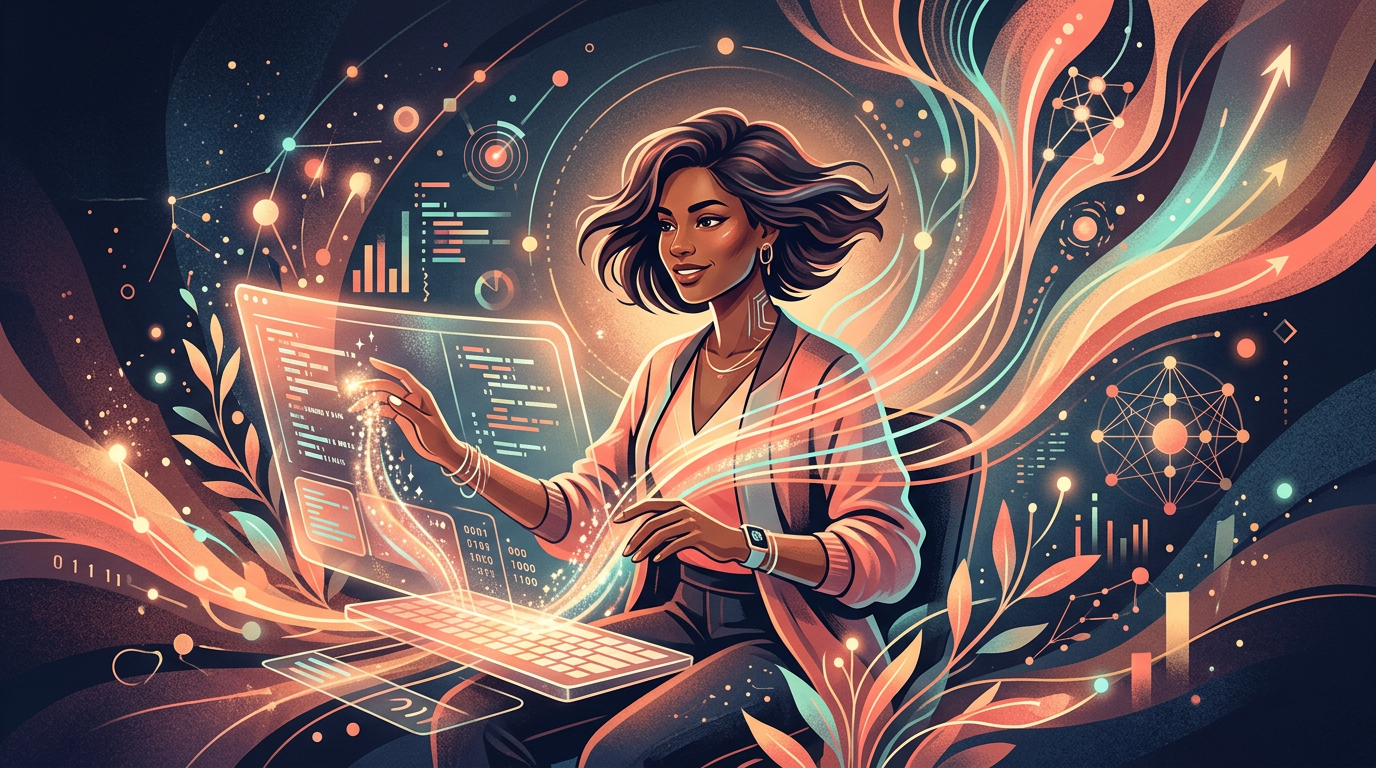
The New Era of Creation: Vibe Coding Tips for Beginners
The technological landscape is shifting beneath our feet, moving away from the rigid constraints of traditional syntax and toward a more fluid, intuitive way of building. This movement is known as vibe coding. If you have ever felt that the barrier to entry for software development was too high - or too dry - vibe coding offers a refreshing alternative. It is about using natural language, clear intent, and a strong sense of aesthetics to direct AI in creating functional, beautiful applications.
For many, the transition into tech has felt like learning a foreign language while blindfolded. Vibe coding changes the narrative by putting the emphasis on the 'vibe' - the vision, the user experience, and the desired outcome. As we explore vibe coding for women, we find that this approach aligns perfectly with strengths often underserved in traditional engineering: empathy, design thinking, and holistic problem-solving. This guide provides actionable vibe coding tips for beginners to help you move from a curious observer to a confident creator.
Understanding the Vibe Coding Mindset
Before diving into the tools, it is crucial to understand that vibe coding is a mental shift. In traditional programming, you are the translator between human needs and machine code. In vibe coding, you are the conductor of an orchestra. The AI is your highly skilled ensemble, and your job is to provide the sheet music and the tempo.
To succeed, you must embrace the idea of 'iterative conversation.' You are not just giving a command; you are refining a vision. If the AI produces something that does not quite fit, you do not need to debug lines of C++ or Python. Instead, you describe what is missing. This process requires a blend of creative direction and logical clarity. To get a head start on the terminology we use in this space, visit our glossary for a breakdown of common concepts.
1. Start with a Clear North Star
The most common mistake beginners make is being too vague. While the AI is powerful, it cannot read your mind. Before you open a terminal or a chat interface, define exactly what you want to achieve.
Consider a scenario where you want to build a personal habit tracker. Instead of saying 'make me a habit tracker,' try to define the 'vibe' of the app. Is it minimalist and calming? Is it high-energy and gamified? Defining these attributes early helps the AI choose the right color palettes, UI components, and interaction patterns. This clarity is the foundation of effective vibe coding tips for beginners.
2. Leverage Natural Language as Your Primary Tool
One of the most empowering aspects of this movement is that your primary tool is the language you already speak. However, not all prompts are created equal. To get the best results, use the 'Context-Action-Constraint' framework:
- Context: Tell the AI who it is (e.g., 'You are an expert UX designer') and what the project is.
- Action: Use strong verbs to describe what you want the code to do.
- Constraint: Define what the AI should avoid or the specific style it must follow.
By framing your requests this way, you reduce the 'hallucinations' or errors the AI might produce. If you want to dive deeper into this specific methodology, our /vibecodher page offers a detailed breakdown of how we approach these interactions.
3. Embrace the Power of Cursors and IDEs
While you can vibe code in a simple chat window, using a specialized Integrated Development Environment (IDE) like Cursor makes the process significantly smoother. These tools are designed to 'see' your entire project folder, allowing the AI to understand how different files interact.
When using an AI-native IDE, you can highlight a block of code and simply ask, 'Make this button look more like a vintage postcard.' The AI will then suggest the CSS changes necessary to achieve that look. This visual and immediate feedback loop is essential for staying in the 'flow state' that characterizes high-level vibe coding.
4. Join a Supportive Ecosystem
Learning in isolation is one of the hardest ways to master a new skill. The vibe coding movement is inherently social and collaborative. At kacibrown.co, we are proud to foster the women-led vibe coding community, where we prioritize collaboration over competition.
Being part of the first women-led vibe coding community, VibecodHER, gives you access to real-time feedback and shared 'vibe' templates. When you see how others describe their visions, it helps you refine your own vocabulary for directing AI. You can find more information about our collective missions and gatherings at our community hub.
5. Master the Art of the 'Re-Vibe'
Rarely will the AI get the code perfect on the first try. The 're-vibe' is the process of taking the AI's output and steering it back on track. If the code works but looks ugly, your next prompt should focus entirely on aesthetics. If it looks great but the buttons do not work, your focus shifts to functionality.
Think of this like sculpting. You start with a block of marble (the initial prompt), and you slowly chip away the excess until the masterpiece is revealed. Patience is your greatest asset here. Instead of getting frustrated when the AI misses the mark, treat it as a data point that helps you refine your next instruction.
6. Focus on the User Journey
Technical skills can be taught, but empathy is a superpower in the world of vibe coding. Because you are not bogged down by syntax, you have the mental bandwidth to focus on the user. How does it feel to click this button? Is the navigation intuitive for someone who is not tech-savvy?
By focusing on the user journey, you ensure that the software you build actually solves a problem rather than just existing as a technical feat. This holistic approach is a cornerstone of the philosophy we teach in our workshops, where we bridge the gap between technical execution and human-centered design.
Actionable Steps for Your First Vibe Coding Project
Ready to get started? Follow these steps to launch your first mini-project:
- Identify a simple problem: Choose something small, like a personal landing page or a simple calculator.
- Set up your environment: Download a tool like Cursor or use an AI platform that allows for multi-file editing.
- Draft your 'Vibe Document': Write one page describing the look, feel, and function of your project.
- Prompt the foundation: Ask the AI to generate the basic structure (HTML/CSS) first.
- Iterate on features: Add one feature at a time, testing as you go.
- Share your progress: Post your results in a supportive group to get feedback.
Why Vibe Coding is the Future for Women in Tech
For a long time, the tech industry has been defined by a 'gatekeeper' mentality - the idea that you are only a 'real' developer if you can write complex algorithms from scratch. Vibe coding breaks these gates down. It values the vision over the syntax.
By utilizing vibe coding tips for beginners, women can bypass years of traditional schooling and go straight to the creation phase. This does not mean the work is easy; it means the work is different. It is more about communication, design, and logic than it is about memorizing semicolons. This shift is empowering a new generation of founders and creators who are building tools that look and feel different from the status quo.
Practical Advice: Overcoming 'Prompt Fatigue'
Sometimes, you might feel like you are talking in circles with the AI. This is known as prompt fatigue. When this happens, the best thing to do is to reset. Start a new chat thread, provide the code you have so far, and re-state your goal with fresh eyes. Often, a slight change in how you describe a problem can unlock the solution immediately.
Also, do not be afraid to ask the AI for help with your prompts. You can ask, 'I want to achieve X, how should I phrase my request to you to get the best result?' This meta-conversation is a highly effective way to learn the nuances of the tool you are using.
Summary of Key Takeaways
- Vision is Primary: Your ability to describe a desired outcome is more important than knowing how to code it manually.
- Iterative Process: Treat building as a conversation, not a one-off command.
- Tools Matter: Use AI-native environments to provide better context to the machine.
- Community is Essential: Surround yourself with other creators to accelerate your learning and stay inspired.
- Focus on Feelings: The 'vibe' includes the emotional response a user has to your application.
Frequently Asked Questions
What is the difference between vibe coding and traditional coding?
Traditional coding requires the manual writing of syntax in specific programming languages. Vibe coding focuses on using natural language and high-level conceptual instructions to direct AI models that generate the underlying code for you. It emphasizes intent and design over technical implementation.
Do I need to know any programming languages to start vibe coding?
While a basic understanding of how the web works (like knowing what HTML or CSS is) can be helpful, it is not a requirement. Many successful vibe coders start with zero technical background and learn the necessary concepts as they go through the process of building.
Is vibe coding just for simple apps?
No. While beginners should start small, vibe coding can be used to build complex, full-stack applications. The limit is generally defined by the creator's ability to provide clear architectural direction and the AI's current context window capabilities.
Where can I find other women who are vibe coding?
You can join the women-led vibe coding community through our dedicated platforms. Connecting with others allows you to share prompts, troubleshoot issues, and collaborate on projects in a supportive environment.
How do I stay updated on the latest vibe coding tools?
The field of AI is moving incredibly fast. The best way to stay updated is to participate in active communities, attend workshops, and regularly experiment with new AI models and IDE updates as they are released. Building your own software is no longer a distant dream reserved for those with computer science degrees. With the right mindset and a supportive network, you can start creating today. The world needs your unique perspective and your specific 'vibe.' Join the free VibecodHER community