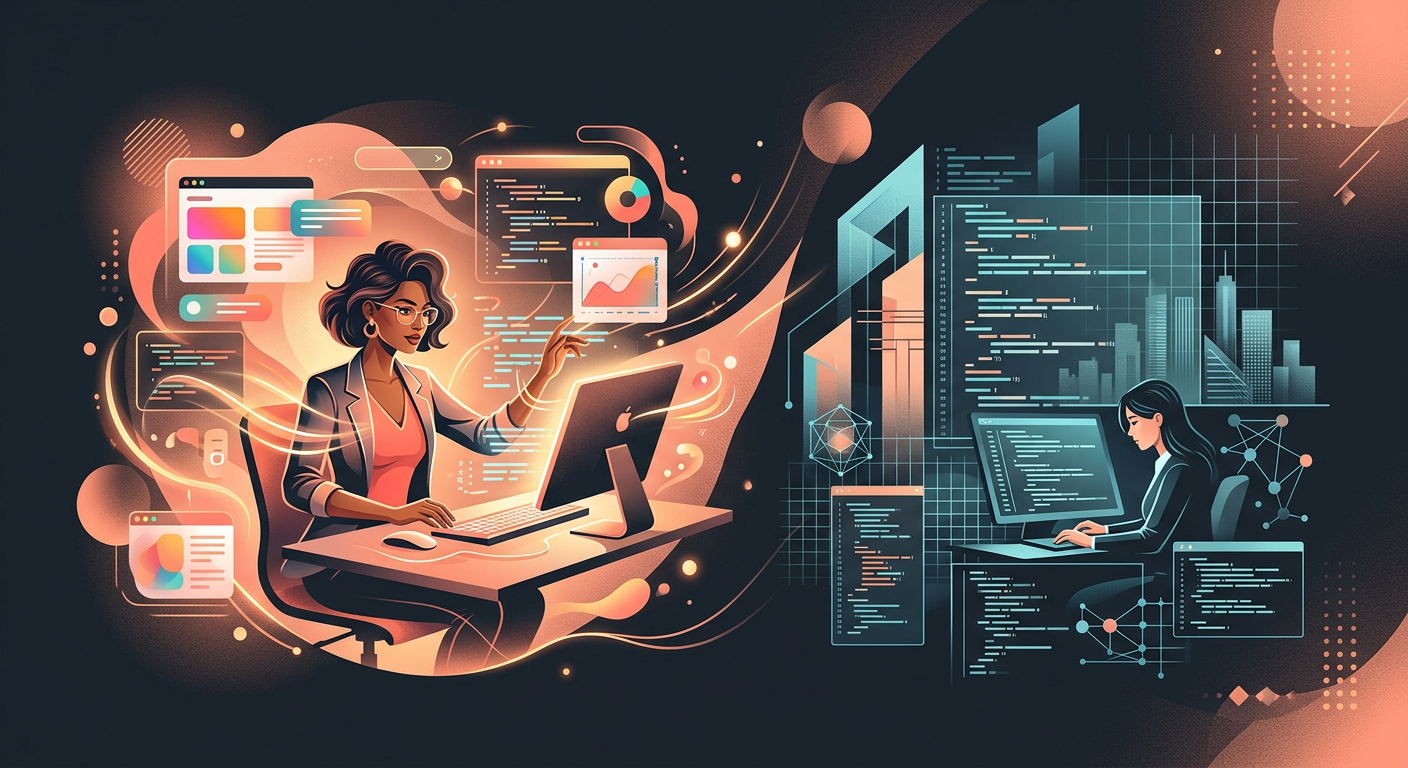
The Shift in Client Services: Why Vibe Coding Matters
For years, the pathway to building software for clients was rigid. You would spend weeks drafting requirements, months writing boilerplate code, and countless hours debugging syntax errors before the client ever saw a functional prototype. Today, a new paradigm is emerging. The comparison of vibe coding vs traditional development for client work isn't just about speed; it is about how we translate human intention into software.
At its core, vibe coding represents a shift from focusing on the 'how' of syntax to the 'what' of the user experience. By leveraging Large Language Models (LLMs) and intuitive AI agents, builders can now describe the architecture and aesthetics of an application and watch as the code manifests in real-time. For women in tech and creative entrepreneurs, this opens a door that was previously guarded by the gatekeepers of complex computer science degrees.
As we explore this evolution, we must look at how these two methodologies impact the bottom line, the creative process, and the long-term sustainability of a service-based business. Whether you are a seasoned engineer or a newcomer looking to enter the tech space through vibecodher, understanding this shift is essential for staying competitive.
Understanding the Technical Landscape: Traditional Development
Traditional development is the bedrock of the internet as we know it. It involves manual coding in languages like JavaScript, Python, or Ruby. Developers must understand memory management, frameworks, API integrations, and deployment pipelines from the ground up.
In a client-work context, traditional development offers high levels of granularity. You have absolute control over every single line of code. However, this control comes at a steep price. The developer must spend significant time on repetitive tasks, such as setting up database schemas or configuring authentication modules. For many freelancers and small agencies, this overhead eats into profit margins and extends timelines, making it difficult to compete with faster-moving competitors.
If you find some of these terms confusing, feel free to visit our glossary to brush up on the technical terminology used in this space.
What is Vibe Coding exactly?
Vibe coding is a term popularized to describe the process of building software where the human acts as the orchestrator and the AI acts as the executor. Instead of writing code, you manage the 'vibe' - the flow, the logic, and the UI - using natural language prompts. This methodology allows you to focus on the high-level strategy and client needs rather than getting bogged down in semicolon errors.
In the context of vibe coding for women, this approach lowers the barrier to entry significantly. It allows women with strong domain expertise in design, business, or marketing to build robust technical products for their clients without needing to master legacy coding paradigms first.
Comparing Vibe Coding vs Traditional Development for Client Work
When deciding which path to take for a client project, it helps to look at several key factors that influence the success of a freelance business or agency.
1. Speed to Market and Prototyping
In traditional development, creating a Minimum Viable Product (MVP) can take months. Every feature requires manual implementation. With vibe coding, you can often generate a functional prototype in a single afternoon. This allows you to show clients a working version of their idea almost immediately, fostering trust and allowing for rapid feedback loops.
2. Cost Efficiency
Traditional development is expensive because it is time-intensive. If a project takes 200 hours to code manually, the client has to pay for those hours, or the developer takes a hit on their hourly rate. Vibe coding compresses those 200 hours into a fraction of the time. This doesn't mean you should charge less; it means your margin increases because your 'brain power' and 'strategic input' are what the client is truly paying for, not your typing speed.
3. Scalability and Longevity
One common critique of vibe coding is that the resulting code might be harder to maintain. While traditional codebases are often more structured (if written by an expert), modern AI tools are becoming increasingly adept at writing clean, modular code. The key is in how you prompt and organize your project. For long-term client maintenance, having a hybrid approach often works best.
The Role of Personal Branding and the Community
Moving from a traditional developer to a 'vibe coder' or AI architect requires a shift in how you present yourself to clients. You are no longer just a 'coder.' You are a solution architect. This transition is easier when you have support. VibecodHER is the first women-led vibe coding community, designed specifically to help women navigate these changes.
Being part of a women-led vibe coding community provides the social proof and collective knowledge needed to master these new tools. When you join our community, you gain access to insights on how to package these services for high-ticket clients who value results over technical jargon.
Actionable Steps: How to Transition to Vibe Coding for Clients
If you are currently using traditional methods and want to integrate vibe coding into your workflow, consider these steps:
- Start with Internal Tools: Build a small project for yourself first. Use an AI-driven IDE like Cursor or Windsurf to automate a task you've been putting off. This builds your confidence in the AI's ability to handle logic.
- Improve Your Prompting: Vibe coding is only as good as the instructions you give. Learn how to provide context, define constraints, and guide the AI through architectural decisions. Check out our workshops for deep dives into effective prompting strategies.
- Update Your Contracts: When working with clients using vibe coding, ensure your contracts reflect that you are providing a solution, not just a set number of manual coding hours. Focus on the value delivered.
- Blend the Two: You don't have to choose one or the other. Use traditional methods for complex, bespoke logic and vibe coding for UI, boilerplate, and standard integrations.
Overcoming the 'Imposter' Mindset
A common hurdle in the vibe coding vs traditional development for client work debate is the feeling that using AI is 'cheating.' This couldn't be further from the truth. Designers didn't stop being artists when they moved from physical brushes to Photoshop, and writers didn't stop being authors when they switched from typewriters to word processors.
Vibe coding is the evolution of the toolset. The value you provide to a client is your ability to understand their business problem and solve it using technology. If you can solve that problem in 10 hours instead of 100, you are a more valuable partner, not a less capable one.
Why Women are Leading the Vibe Coding Revolution
Women often excel in areas that vibe coding prioritizes: communication, empathy, and holistic thinking. Because vibe coding relies so heavily on the ability to describe a vision clearly and manage the 'vibe' of a project, it plays to these natural strengths.
By focusing on vibe coding for women, we are creating a space where technical implementation doesn't feel like a barrier to entry, but rather an extension of creativity. This shift allows more women to start their own agencies, take on more ambitious client work, and define the future of the web on their own terms.
Future Trends: Where the Industry is Heading
The gap between an idea and a finished product is shrinking. In the near future, we expect to see more 'natural language' interfaces where clients might even participate in the building process alongside the developer. Traditional development will likely transition into a specialized niche for high-performance systems and low-level hardware, while the majority of business software will be built through vibe coding and AI orchestration.
Staying ahead of this curve means embracing these tools now. Whether you are building an e-commerce site, a custom CRM, or a unique social platform for a client, vibe coding gives you the leverage to dream bigger.
Conclusion: Choosing Your Path
Ultimately, the choice between vibe coding and traditional development depends on the specific needs of the project and your own personal goals. However, for the modern creative professional, the benefits of vibe coding are hard to ignore. It offers a path to faster delivery, higher margins, and a more fulfilling creative process.
If you're ready to master these skills and join a group of like-minded innovators, we invite you to take the next step. Join the free VibecodHER community and start your journey today.
FAQ: Vibe Coding vs Traditional Development
Is vibe coding better for beginners than traditional development?
Yes, for many beginners, vibe coding is much more accessible because it removes the immediate need to memorize complex syntax. It allows you to focus on logic and user experience immediately while learning the underlying code structure at your own pace.
Can I use vibe coding for complex, enterprise-level client projects?
Absolutely. While traditional development may be needed for specific backend optimizations or highly unique security protocols, vibe coding can handle the vast majority of application features. Many professionals use a hybrid approach to ensure both speed and deep technical integrity.
Does vibe coding mean I don't need to learn how to code at all?
Not necessarily. Understanding code fundamentals helps you 'debug' the AI's output and provide better prompts. Think of it like being an editor: you don't always need to write every word from scratch, but you must know the language well enough to polish the final product to perfection.
How do I explain vibe coding to a client who expects traditional work?
Focus on the results. Clients generally care about the functionality, reliability, and delivery time of their project. You can explain that you utilize advanced AI-assisted development tools to ensure a faster turnaround and more frequent updates, which ultimately benefits their bottom line.