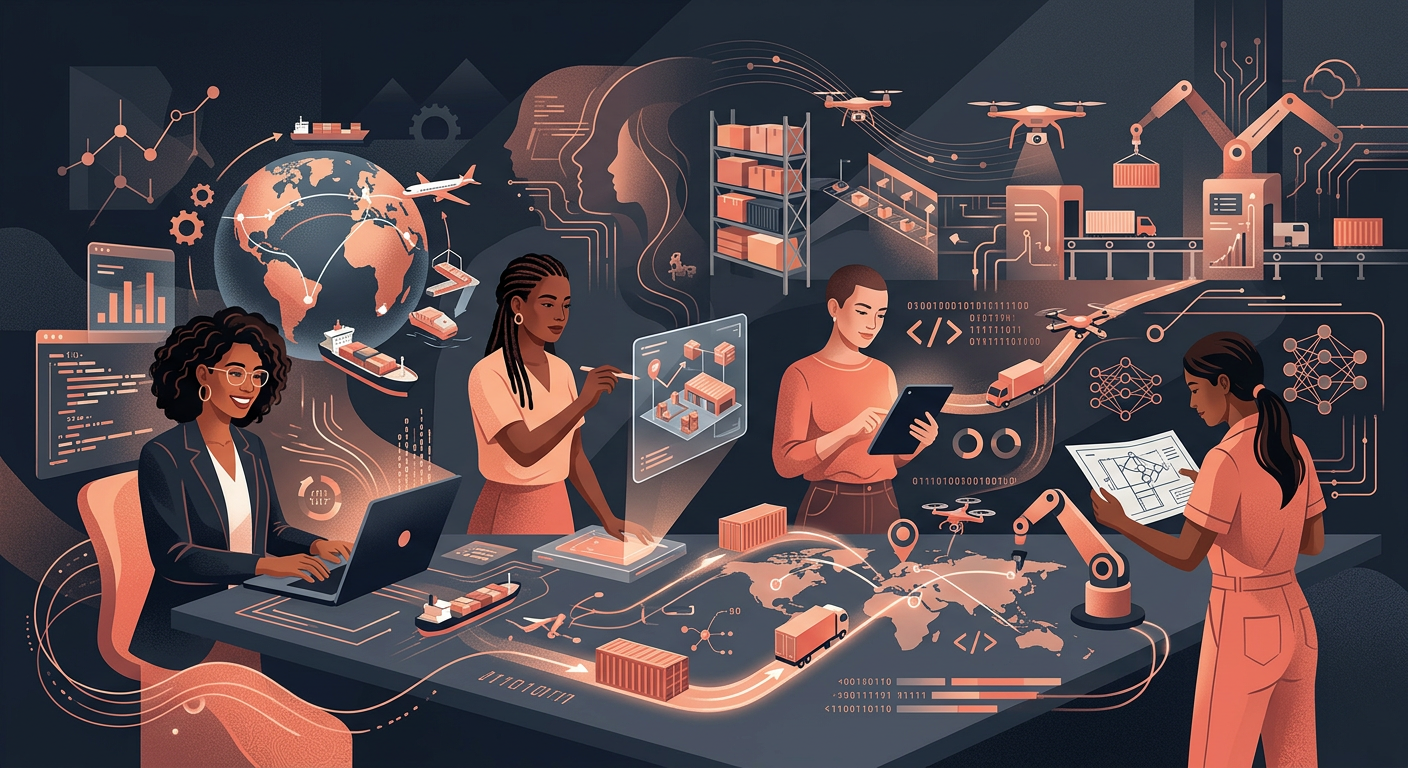
The New Era of Supply Chain Innovation
Logistics has long been considered the backbone of the global economy, yet it has traditionally been a field dominated by manual processes and legacy systems. This is changing rapidly. We are currently witnessing a seismic shift where artificial intelligence is not just an add-on but the core engine of global trade. At the center of this transformation are women who are leveraging cutting-edge technology to solve some of the most complex problems in movement, storage, and distribution.
When we talk about women leading the logistics AI revolution, we are talking about a movement that prioritizes efficiency, sustainability, and human-centric design. This revolution is powered by more than just traditional software engineering; it is being fueled by a new approach to creation. By using AI agents and intuitive technical frameworks, women are dismantling the barriers to entry that once kept them out of high-level technical roles in the supply chain sector.
Why Logistics is Ripe for AI Transformation
The logistics industry is a massive ecosystem of moving parts. From predictive demand forecasting to last-mile delivery optimization, the potential for error is high, and the margins are often thin. AI provides the precision needed to navigate these challenges. Women in this space are focusing on several key areas:
- Predictive Analytics: Moving from reactive to proactive maintenance and stock management.
- Autonomous Coordination: Building systems where AI agents communicate to optimize routes in real time.
- Sustainability Tracking: Using machine learning to reduce carbon footprints by identifying the most fuel-efficient transport methods.
- Risk Mitigation: Analyzing global data to predict port congestion or weather disruptions before they happen.
These innovations require a deep understanding of both technology and operational reality. This is where the concept of vibe coding for women becomes a competitive advantage. It allows builders to focus on the high-level logic and desired outcomes of a system without getting bogged down in the syntax of legacy languages.
The Power of Vibe Coding in Logistics
Vibe coding is the process of using natural language and intent to direct AI in building functional applications. For a woman working in logistics, this means she can describe a complex warehouse management system to an AI assistant and see a prototype come to life in hours rather than months.
This democratization of development is a core pillar of the women-led vibe coding community that we are building here. When women can translate their domain expertise directly into software, the resulting tools are more intuitive and effective. In logistics, this looks like building custom AI dashboards that track shipment health or creating specialized bots that manage vendor communication without needing a massive engineering team.
By leveraging the resources in our glossary, women can quickly learn the terminology of the AI era and start applying it to logistical challenges immediately. The shift is moving away from "how do I write this line of code?" and toward "how do I design this system to be more resilient?"
Practical Applications: Building Logistics Tools with AI
If you are looking to enter or advance within the logistics AI space, the path forward involves mastering the orchestration of AI agents. Imagine a scenario where a logistics coordinator needs to manage a sudden disruption in a shipping lane. Instead of manually calling carriers and recalculating costs, she uses an AI-powered tool she built herself.
Phase 1: Identifying the Friction Point
Before building, you must identify a specific problem. In logistics, this might be high rates of cargo damage or inefficient documentation processes. Narrowing your focus allows you to build a specialized AI agent that performs one task exceptionally well.
Phase 2: Architecting the Solution
Using the principles taught in our workshops, you can begin architecting an AI agent. This involves defining the data sources the agent should access, such as real-time weather feeds, traffic data, or inventory databases.
Phase 3: Vibe Coding the MVP
This is where the magic happens. By describing the workflow to a large language model, you can generate the necessary scripts to connect your data sources to a front-end interface. You are not just a user of software; you are the architect. This sense of agency is what defines the first women-led vibe coding community, VibecodHER.
Overcoming Industry Barriers
Despite the progress, the logistics and tech sectors still present challenges for women. Information silos and a lack of mentorship can slow down growth. This is why joining a community is essential. When women share their workflows, prompts, and successes, the entire group moves faster.
Women leading the logistics AI revolution are doing so by creating their own seats at the table. They are not waiting for traditional IT departments to build the tools they need. They are building them in public, testing them in real-world environments, and iterating based on the data they receive.
The Role of AI Agents in Modern Supply Chains
AI agents are the workforce of the future in logistics. Unlike traditional software that follows a rigid if-this-then-that logic, AI agents can make autonomous decisions based on the parameters you set.
- Procurement Agents: Automatically finding the best prices for raw materials based on market trends.
- Customer Success Agents: Providing real-time updates to clients regarding their shipments with a human-like touch.
- Compliance Agents: Ensuring all international shipping documents meet the specific legal requirements of different jurisdictions.
By focusing on these agentic workflows, women are creating more robust and flexible supply chains. The ability to manage these agents through natural language - the essence of vibe coding - is the ultimate leverage.
Actionable Steps for Aspiring AI Logistics Leaders
If you want to be part of this revolution, here is how you can start today:
- Learn the Framework: Understand the basics of how LLMs work and how they can be used to generate code. Our vibecodher section is a great place to start.
- Identify a Use Case: Look at your current workflow. Where is the most manual, repetitive effort? That is your first AI project.
- Build an MVP: Use an AI coding assistant to create a basic tool that solves that one problem. Do not worry about perfection; focus on utility.
- Join a Network: Connect with other women who are building. Sharing your progress in our community provides the feedback loop necessary for rapid growth.
- Iterate and Expand: Once your first tool is working, look for ways to connect it to other systems to create a more comprehensive AI ecosystem.
The Future of Women in Logistics Tech
The future is bright for women who choose to embrace the AI revolution. As logistics becomes increasingly digitized, those who understand how to guide and direct AI will be the most valuable assets in any organization. We are moving toward a world where the "vibe" of the system - its intent, its ethics, and its efficiency - is just as important as the underlying code.
By participating in the first women-led vibe coding community, you are positioning yourself at the forefront of this shift. You are not just following a trend; you are building the foundation for a more intelligent and equitable global supply chain.
FAQ: Women in Logistics AI
What is vibe coding and how does it apply to logistics?
Vibe coding is an approach to development where the creator uses natural language and high-level intent to build software with AI. In logistics, this allows professionals to build custom tracking tools, optimization scripts, and data dashboards without needing a traditional computer science background.
Do I need to be a developer to lead in the logistics AI revolution?
No. The current wave of AI tools is designed to empower domain experts. While technical literacy is important, your understanding of logistics operations is your most valuable asset. AI handles the heavy lifting of coding, allowing you to focus on system design and strategy.
What are the benefits of joining a women-led vibe coding community?
Being part of the women-led vibe coding community provides a safe space to experiment, ask questions, and share resources. It offers mentorship from others who understand the unique challenges women face in both the tech and logistics industries, fostering a collaborative rather than competitive environment.
How is AI making logistics more sustainable?
AI contributes to sustainability by optimizing routes to reduce fuel consumption, predicting demand to minimize overproduction and waste, and identifying opportunities for circular economy practices within the supply chain. Women leaders are often at the forefront of integrating these green initiatives into AI strategies.
Start Your AI Building Journey Today
The logistics industry is waiting for your perspective and your projects. Whether you want to optimize a small local delivery route or overhaul a global shipping network, the tools are now in your hands.