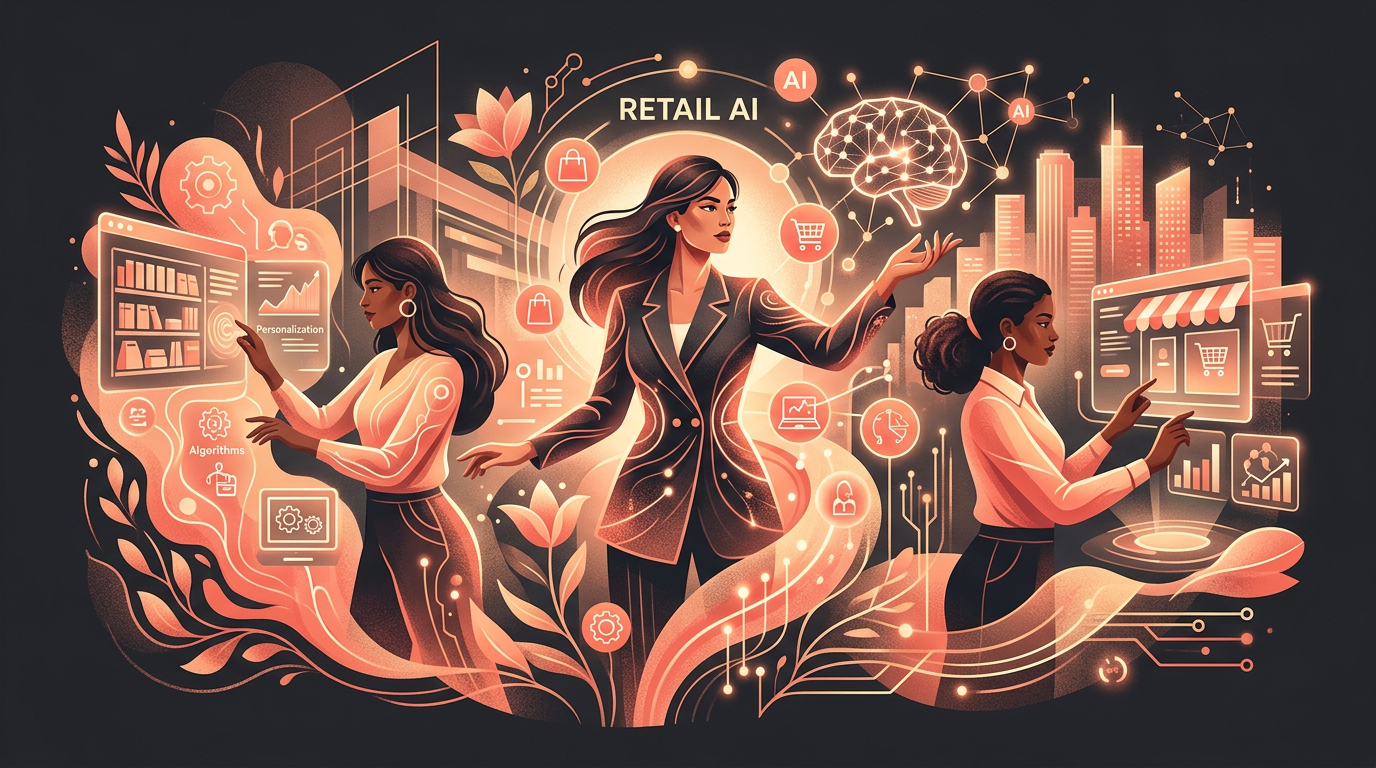
The Shift: How Women Are Rewriting the Retail Script
Retail has always been an industry built on intuition, aesthetic, and connection. Today, those same qualities are being translated into digital systems by pioneering women who are merging traditional commerce with cutting-edge artificial intelligence. We are witnessing a profound shift where the focus has moved from simple automation to sophisticated, human-centric experiences. This movement, characterized by women leading the retail AI revolution, is not just about making shopping faster - it is about making it more meaningful.
For decades, tech-driven retail meant clunky inventory systems or basic search bars. Now, female developers and visionaries are using AI to predict trends, solve sustainability challenges, and create virtual styling experiences that feel deeply personal. At the heart of this transformation is a concept we advocate for deeply: vibe coding. By prioritizing the 'vibe' or the intent and feeling of a digital experience, these leaders are proving that the most successful retail tech is that which understands the human behind the transaction.
Understanding the Retail AI Landscape through Vibe Coding
To understand how women are leading the retail AI revolution, we must first look at the tools they are using. Many are moving away from the rigid frameworks of the past and embracing flexible, AI-led development environments. This approach allows creators to focus on the outcome and the user experience rather than getting bogged down in syntax.
In our glossary, we define several terms that are becoming standard in the retail tech space. From natural language processing (NLP) to predictive analytics, these technologies allow a brand to 'speak' to a customer. Imagine a shop that knows your style preferences not just from your past purchases, but from the aesthetic you interact with across social platforms. This is the level of personalization that female-led AI startups are currently building.
The Importance of Human-Centric Design
Women in tech tend to approach problem-solving with high levels of empathy. In retail, this translates to AI that reduces friction rather than creating it. Instead of a generic chatbot, female innovators are building AI stylists that understand context. They recognize that a user looking for a dress for a wedding in Italy has different needs than someone looking for professional attire. This nuance is where women leading the retail AI revolution are truly separating themselves from the competition.
Actionable Strategies for Entering the Retail AI Space
If you are looking to pivot into this space or start your own AI-powered retail venture, there are specific steps you can take to harness this momentum. You do not need a computer science degree to get started; you need a vision and the right tools to bring that vision to life.
- Identify a Niche Pain Point: Look at the current retail journey. Is it the sizing issue? The lack of sustainable choices? The difficulty of finding unique items? Start where there is a gap in the vibe.
- Experiment with Low-Code/No-Code AI: You can start building prototypes today using tools that interpret natural language. This is a core pillar of what we teach at vibecodher.
- Build Your Network: Innovation does not happen in a vacuum. Connecting with other women who are navigating the same challenges is vital for long-term success. Our community is a great place to find collaborators.
- Focus on Data Ethics: As a leader in AI, you have the responsibility to handle consumer data with integrity. Ensuring privacy and transparency should be a foundation of your build.
Case Studies of Innovation
Consider the impact of a female-led startup focused on circular fashion. By using AI to track the lifecycle of a garment, these leaders are making it easier for consumers to buy, sell, and recycle clothes. This is not just a commercial success; it is an environmental one. The AI identifies the fabric composition, estimates the resale value, and connects the seller to a buyer who values that specific brand. This 'smart' resale market is a direct result of women leading the retail AI revolution.
In another example, look at the rise of virtual try-on technology. Many of the most successful AR (Augmented Reality) integrations in the beauty industry have been driven by female product managers and engineers who understood that digital makeup application needed to look realistic across all skin tones. They used AI to correct lighting and texture discrepancies, ensuring that the technology was inclusive from day one.
Scaling Your Vision with Professional Guidance
For many women, the barrier to entry isn't a lack of ideas but a lack of technical confidence. This is why we created our workshops. We break down the complexities of AI building into digestible, actionable lessons. Whether you want to build a custom GPT for your boutique or an advanced inventory forecasting model, the path starts with understanding how to communicate with AI.
When we talk about the 'revolution,' we are talking about a democratization of technology. The tools that used to be reserved for billionaire corporations are now accessible to independent creators. Women leading the retail AI revolution are leveraging this accessibility to disrupt legacy brands that are too slow to adapt.
The Role of Community in Female-Led Innovation
The tech industry can often feel isolating, especially for women in leadership roles. However, the retail AI space is uniquely collaborative. We see a trend of 'co-opetition,' where female founders support each other while building competing products. This community-first mindset accelerates growth for everyone involved.
By joining a community of like-minded builders, you gain access to shared resources, beta testing groups, and emotional support. The journey of building an AI product is filled with iterations. Having a group to troubleshoot with can be the difference between a project that stalls and one that scales.
Future Trends: Where Retail AI is Heading
As we look toward the future, the influence of women leading the retail AI revolution will only grow. We are moving toward 'Invisible Tech' - systems so well-integrated into the shopping experience that the consumer doesn't even realize they are interacting with AI. Here are a few trends to watch:
- Hyper-Localized Inventories: AI will allow small retailers to curate their stock based on hyper-local data, ensuring they always have exactly what their specific neighborhood needs.
- Voice-First Commerce: As voice assistants become more sophisticated, women are leading the charge in making these interactions feel natural and helpful rather than robotic.
- Sustainable Supply Chains: AI will be the primary tool for reducing waste in the fashion industry. Predictive modeling will ensure that production matches demand, ending the era of mass overproduction.
Key Takeaways for Aspiring AI Builders
Leading the retail AI revolution requires a blend of creative vision and technical execution. Remember that the goal is not to use AI for the sake of using it, but to use it to solve a genuine human problem. If you can make a consumer feel seen, understood, and valued, you have already won.
Start by mastering the basics of vibe coding. Learn how to prompt effectively, how to structure your data, and how to iterate quickly based on feedback. The retail world is waiting for your perspective.
FAQ: Women Leading the Retail AI Revolution
Do I need a background in coding to start a retail AI business?
No. With the rise of vibe coding and no-code AI tools, the barrier to entry has never been lower. While understanding the logic of how AI works is essential, you do not need to be a traditional software engineer to build and lead a successful AI-driven company.
How does AI improve sustainability in retail?
AI helps retailers predict demand with incredible accuracy, which means they produce only what they are likely to sell. It also optimizes logistics to reduce carbon footprints and identifies materials that are easier to recycle, making the entire lifecycle of a product more sustainable.
What is 'vibe coding' in the context of retail?
Vibe coding refers to the process of building applications where the developer focuses on the creative intent and user experience (the vibe) while the AI handles the heavy technical lifting. In retail, this means creating digital storefronts that feel like high-end physical boutiques through natural interaction and thoughtful design.
Where can I find other women building in this space?
Finding a supportive network is crucial. You can begin by exploring our community or joining vibrant groups of innovators who are passionate about the intersection of AI and commerce.
If you are ready to take the next step in your journey and want to learn from women who are actually building the future, we invite you to join us. The best way to stay ahead of the curve is to surround yourself with people who are already moving.
Join the free VibecodHER community
Build with the First Women-Led Vibe Coding Community
You don't have to figure this out alone. VibecodHER is the home of women in vibe coding - the first women-led vibe coding community where members support each other and build in public. Join the free Skool community.